
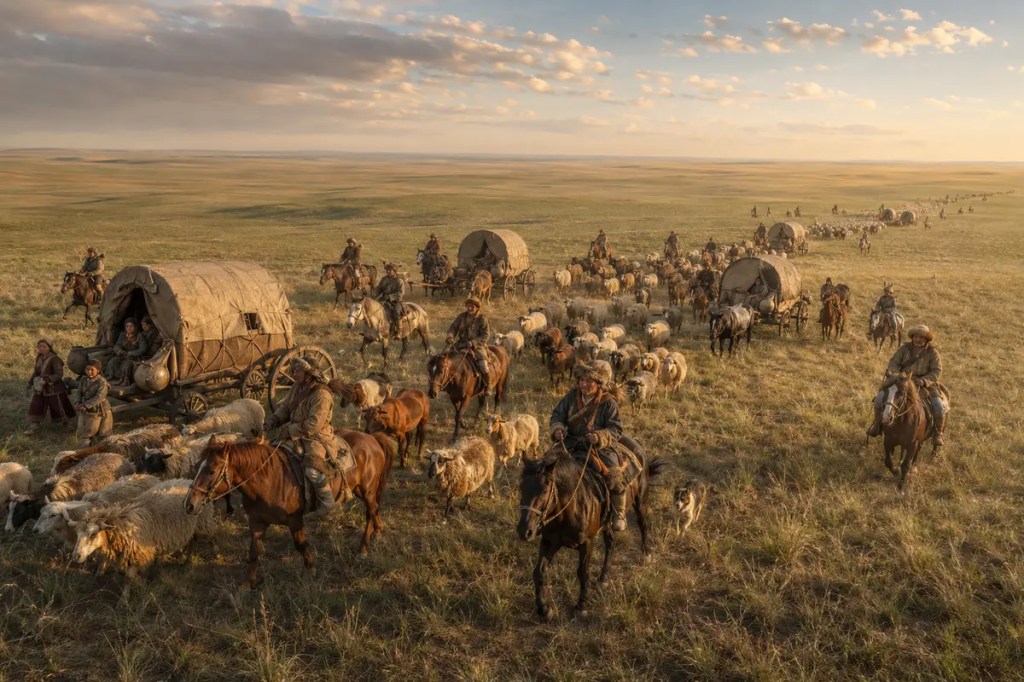
Across the center of Eurasia stretches an immense belt of grassland. From the plains north of the Black Sea through Central Asia and toward Mongolia, the steppe forms a world of wide horizons, scarce forests, uneven rainfall, and enormous distances. To settled societies, it could appear empty. To the people who learned to live within it, the steppe was a productive and connected landscape—a grass sea.
A land made for movement
Steppe grasslands could support large herds, but grazing was never unlimited in one place. Pastures changed with the seasons, water sources were scattered, and severe winters or summer droughts could threaten animals. Survival therefore depended on mobility.
Pastoral communities moved horses, sheep, goats, cattle, and sometimes camels between seasonal grazing grounds. Portable dwellings, wagons, felt, leather, and equipment designed for travel allowed households to move with their wealth. Mobility was not aimless wandering. It was an organized response to the geography of grass and water.
Animals turned distance into opportunity
Herd animals converted grass that humans could not eat into milk, meat, wool, hides, transport, and exchangeable wealth. Among them, the horse had a particularly powerful effect. Riding enabled herders to control larger flocks, travel farther, communicate quickly, and respond to sudden changes in weather or danger.
Mounted movement also changed warfare and politics. Skilled riders could scout, raid, retreat, and regroup across distances that exhausted infantry. The same abilities used to manage herds—coordination, endurance, knowledge of terrain, and rapid movement—could support military alliances and expanding confederations.
Power without a city center
In farming regions, power often gathered around permanent fields, walls, temples, and storehouses. On the steppe, political strength could be distributed across mobile groups. Leaders built influence by forming alliances among clans, controlling pasture and routes, exchanging gifts, and sharing the rewards of trade or conquest.
These coalitions could grow with remarkable speed. They could also fragment when leadership weakened or resources became scarce. Steppe empires were not simply unstable copies of settled states. Their flexibility reflected a different environment—one in which people, animals, and authority all had to remain mobile.
The steppe as a corridor
The open grasslands did not merely separate China, Central Asia, the Middle East, and Europe. They connected them. Horses, metals, textiles, artistic styles, technologies, religious ideas, and political practices traveled through networks linking nomadic and settled communities.
Trade was never limited to a single road. Routes shifted with seasons, security, and political power. Steppe peoples acted as carriers, brokers, guides, allies, and rivals. Their relationships with towns and farming societies included exchange as well as conflict. Nomadic and settled worlds shaped each other over centuries.
Art made to travel
Mobility influenced material culture. Portable objects mattered: decorated weapons, horse gear, jewelry, textiles, vessels, and ornaments that could be worn, packed, exchanged, or buried. Across widely separated regions, related animal motifs appeared in the art of steppe societies, while imported luxury goods reveal contact with powerful settled neighbors.
This was not a culture without places. Burial grounds, winter camps, river valleys, sacred landscapes, and meeting sites anchored memory and identity. Yet many of the most important possessions and symbols of status were designed for a life in motion.
The environment behind the empires
The Scythians, Sarmatians, Turkic peoples, Mongols, and many other steppe societies belonged to different periods and cultures. They should not be collapsed into a single “nomadic” identity. Still, they faced recurring possibilities and pressures created by the same broad environment.
Grasslands rewarded herding. Distance rewarded riding. Uncertain pastures rewarded flexibility. Open routes rewarded communication and alliance. From those conditions emerged societies capable of moving people, goods, and power across a continental scale.
The grass sea shaped history
The Eurasian steppe was not an empty margin around the “real” centers of civilization. It was a historical center in its own right. Its ecology shaped a mobile way of life, and that way of life repeatedly changed the political and cultural map of Eurasia.
Nomadic peoples mastered the steppe, but the steppe also shaped their choices. Their reach, resilience, and power began with a simple geographical fact: beyond the horizon lay more grass, more distance, and another route forward.
Further reading: The Metropolitan Museum of Art: Scythian Art and Cultural Interactions in the Black Sea; The Met: Central and North Asia, 1–500 A.D.; UNESCO: Silk Roads, Chang’an–Tianshan Corridor.

