
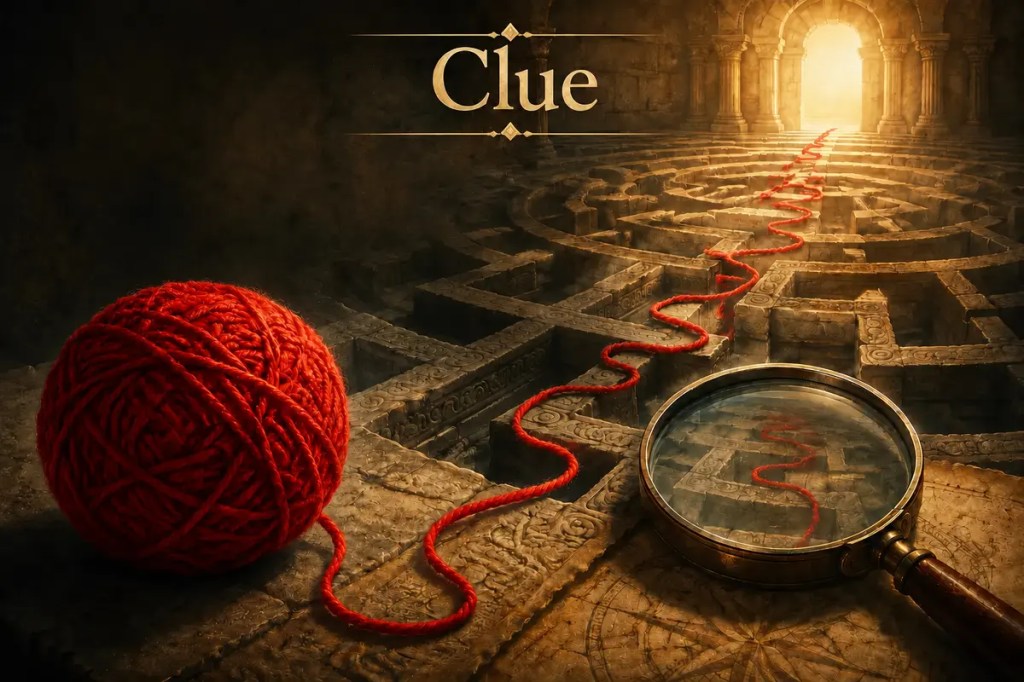
The word clue now means a piece of information that helps solve a mystery, answer a question, or find a way forward. Its history, however, begins not with detectives or evidence, but with a simple ball of thread—and with an ancient story about escaping from a labyrinth.
1. From Clew to Clue
Clue developed as a spelling variant of clew, an old word for a ball of yarn or thread. Clew comes through Middle English clewe from Old English cliewen. Related Germanic words also refer to a rounded mass or ball of thread. For centuries, the word named a physical object rather than a piece of information.
2. The Thread Through the Labyrinth
The change in meaning was shaped by the Greek myth of Theseus and the Labyrinth. Ariadne gave Theseus a ball of thread, which he unwound as he entered the maze and followed back to find his way out. Because the thread guided a person through confusion, clew came to be used figuratively for something that points toward a path or solution. By the early modern period, the spelling clue was becoming established for this guiding sense.
3. The Modern English Meaning
Today, a clue is any fact, sign, object, or detail that helps someone understand what is hidden or uncertain. Detectives follow clues to solve crimes, doctors examine clues to identify illness, and readers use contextual clues to understand unfamiliar words. The expression “not have a clue” means to have no knowledge or understanding at all. Although the original ball of thread has nearly disappeared from everyday use, its guiding function remains at the center of the modern word.
The journey of clue runs from a wound ball of thread to a path through a mythical labyrinth, and finally to the evidence that guides modern thought. The object changed into an idea, but its purpose stayed the same: a clue is something we follow when we do not yet know the way.
 Intellesia