
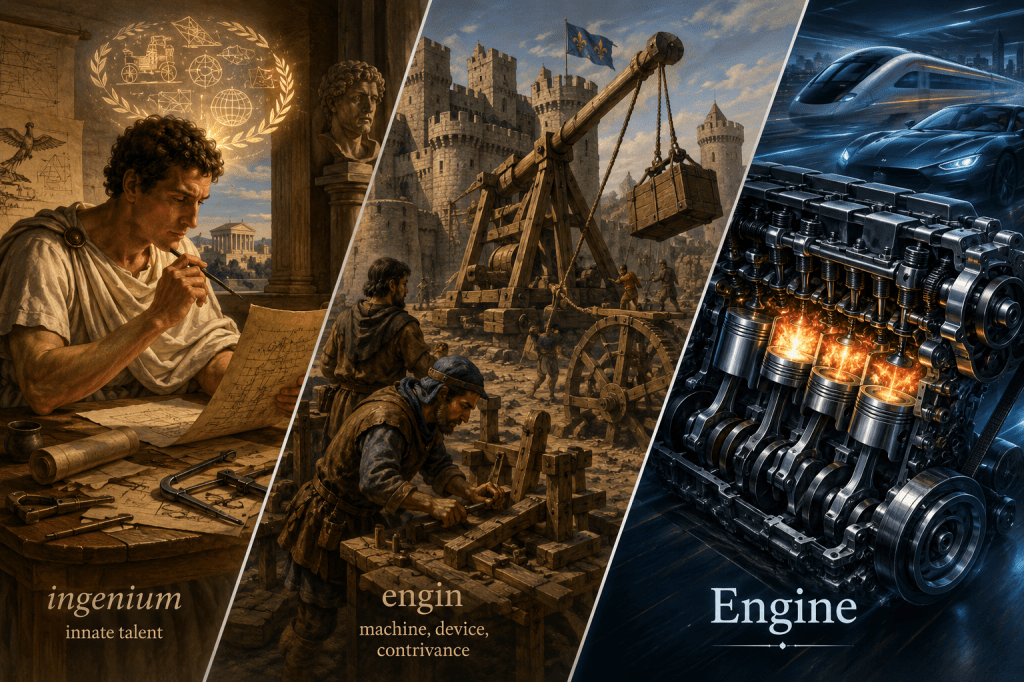
The word engine is deeply tied to human ingenuity and invention, reflecting our long history of creating tools and machines. Today, it commonly refers to mechanical devices that convert energy into motion, but its origin reveals a broader meaning. Its roots trace back to ideas of cleverness and innate talent rather than machinery.
1. Latin Origins
The word engine comes from the Latin term ingenium, meaning “innate talent” or “cleverness.” This root emphasizes mental ability rather than physical objects, highlighting creativity and invention. Over time, the concept of ingenuity became associated with devices created through human skill.
2. Old French Transition
As Latin evolved into Old French, ingenium became engin, meaning “skill,” “cunning,” or “device.” This shift marked a transition from abstract intelligence to practical applications of that intelligence. During the medieval period, engin was often used to describe war machines like catapults.
3. Middle English Development
The term entered Middle English as engine, referring to mechanical devices, especially those used in warfare or construction. Gradually, its meaning expanded to include any machine that performs work or produces motion. This evolution reflects humanity’s increasing reliance on technology and mechanical systems.
Originally rooted in the idea of cleverness, engine evolved to represent the physical embodiments of human ingenuity. Its journey from abstract intelligence to concrete machinery mirrors the development of human civilization. Today, every engine still carries the legacy of innovation embedded in its name.


Leave a Reply