
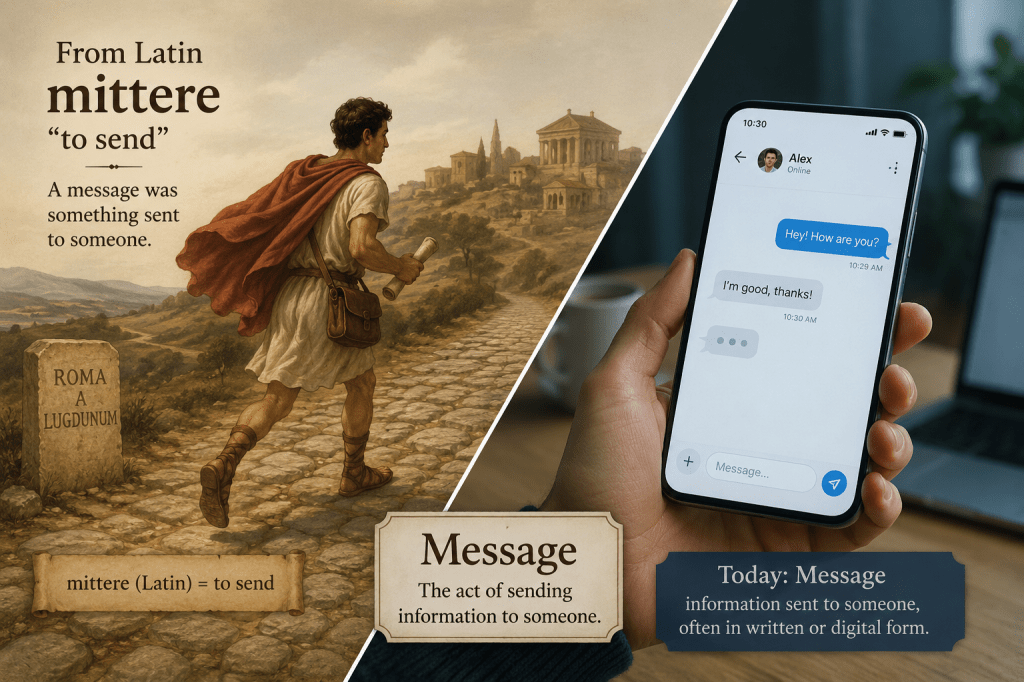
The word message is a familiar term in modern communication, referring to information sent from one person to another. Yet behind this everyday usage lies a long linguistic journey shaped by travel, duty, and speech. Its origin reflects a time when communication depended on physical movement rather than instant transmission.
1. Latin Roots and the Act of Sending
The word message ultimately traces back to the Latin verb mittere, meaning “to send.” From this root came missus, the past participle meaning “sent,” which formed the basis of many related words like mission and missile. This origin highlights that a message was originally defined not by its content, but by the act of being sent.
2. Old French Transformation
In Old French, the term evolved into message, meaning a communication delivered by a messenger. During the medieval period, a message was often verbal or written information carried by an individual across distances. This reflects a world where communication relied on human intermediaries rather than technology.
3. Expansion into Modern Meaning
As English adopted the word message in the late Middle Ages, its meaning gradually broadened. It came to include not only spoken or written communication, but also symbolic or implied meanings. Today, a message can be anything from a text notification to a deeper idea conveyed through art or behavior.
The evolution of message shows how language adapts alongside human communication. From a physical act of sending to an abstract exchange of meaning, the word has expanded with technological and cultural change. Its history reminds us that even the simplest communication once depended on movement, effort, and human connection.
 Intellesia
Leave a comment