
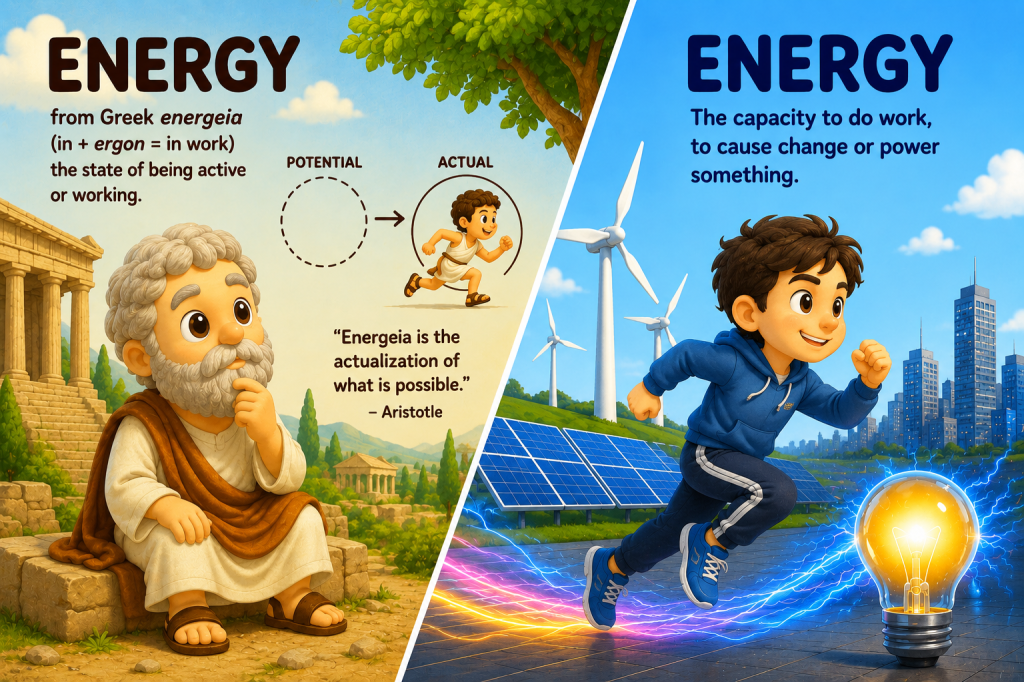
The word “energy” is one of the most important concepts in both science and daily life. It refers to the ability to do work, produce movement, or cause change. Today, the word is strongly connected with physics, electricity, and human activity.
1. Greek Origins
The word “energy” comes from the Ancient Greek word energeia. This word was formed from en- meaning “in” and ergon meaning “work.” Originally, it described the state of being active or working.
2. Philosophical Meaning
The philosopher Aristotle used energeia to describe something existing in action rather than only in possibility. In his philosophy, energy was connected to activity, realization, and function. This idea later influenced medieval and modern scientific thought.
3. Scientific Development
During the 17th to 19th centuries, scientists began using “energy” as a technical scientific term. It became central in physics for describing motion, heat, electricity, and force. Modern physics defines energy as a conserved quantity that can change forms but cannot be destroyed.
The history of “energy” shows how a philosophical idea about activity became one of the foundations of modern science. From Greek philosophy to physics equations, the word has continuously represented power, action, and change. Today, energy is considered one of the fundamental elements of the universe.
 Intellesia
Leave a comment