
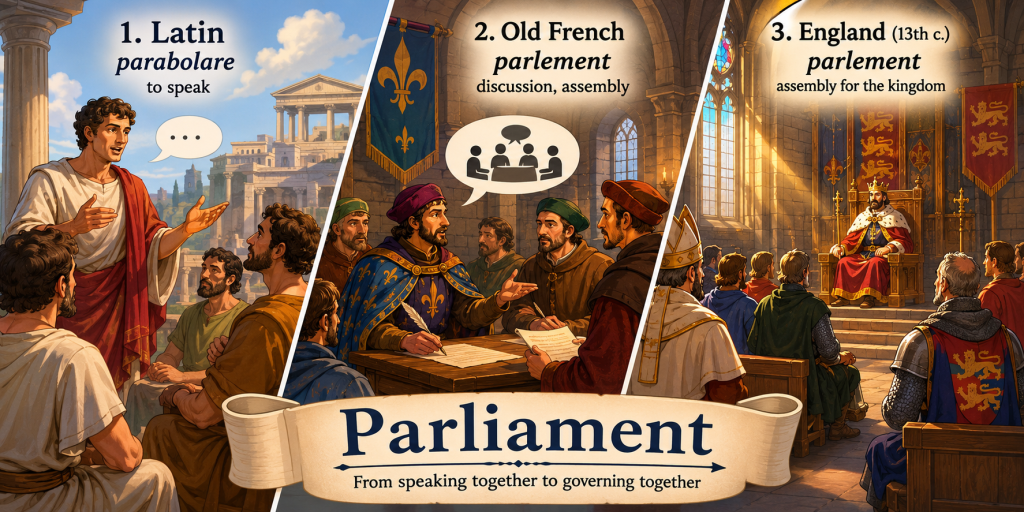
The word parliament refers to a legislative assembly where representatives meet to discuss, debate, and make laws. It is most strongly associated with the parliamentary systems of countries such as United Kingdom. The history of the word reveals how the idea of government developed from formal discussion and consultation.
1. Latin Origins
The ultimate origin of parliament can be traced to the Latin verb parabolare, meaning “to speak” or “to converse.” This developed into Medieval Latin parlamentum, referring to a discussion, conference, or meeting. At this stage, the word emphasized conversation rather than lawmaking.
2. Old French Development
The word entered Old French as parlement, meaning “speech,” “discussion,” or “assembly.” It came from the verb parler, meaning “to speak.” Because important political decisions were often made through discussion among nobles and officials, the word gradually became associated with governing bodies.
3. Political Meaning in England
After the Norman Conquest in 1066, many French words entered English, including parlement. By the 13th century, the term was used for meetings summoned by kings to consult nobles, clergy, and representatives. Over time, these assemblies evolved into the institution now known as Parliament.
The word parliament literally means “a place of speaking” or “a meeting for discussion.” Its journey from Latin conversation to a modern legislative body reflects the principle that government decisions are made through debate and deliberation. Even today, the core idea of Parliament remains rooted in its original meaning: people gathering to talk, discuss, and decide.


Leave a Reply