
When most people think of the Nile River, they imagine pyramids, pharaohs, and ancient Egypt. Yet the Nile was far more than a backdrop to history. It was a powerful natural system that transformed one of the driest regions on Earth into a corridor of life. Without the Nile, Egypt would have remained largely uninhabitable desert. To understand how one of humanity’s most influential civilizations emerged, we must first understand the river itself and the environmental forces it created.
The Nile is one of the world’s longest rivers, flowing northward for more than 6,600 kilometers through northeastern Africa before reaching the Mediterranean Sea. Unlike most major rivers, it travels through vast arid landscapes where rainfall is scarce. This unusual geography made the river extraordinarily important. Rather than merely supporting life, the Nile became the primary source of water, fertile soil, transportation, and ecological stability for millions of people across thousands of years.
The story of the Nile is therefore not simply the story of a river. It is the story of how geography shaped politics, economics, religion, technology, and culture. It is a striking example of how a natural feature can influence the course of human history.
The Natural Dynamics of the Nile
Long before cities appeared along its banks, the Nile was already shaping the landscape through seasonal flooding. Most of the river’s water originated far to the south in the highlands of present-day Ethiopia and the great lakes region of East Africa. Heavy summer rains in these distant regions caused the Nile to swell each year. Months later, floodwaters arrived in Egypt, spreading across the river valley and depositing nutrient-rich sediments. These sediments replenished the soil naturally, making agriculture possible in a region otherwise dominated by desert.
The contrast between the Nile Valley and the surrounding desert was dramatic. To the east and west stretched the vast Sahara Desert, one of the harshest environments on Earth. Yet along the river itself, vegetation flourished. This narrow green corridor created a highly concentrated zone of biological productivity. Plants, animals, and human communities clustered around the river because survival elsewhere was far more difficult.
The river also created the Nile Delta near the Mediterranean coast. As the river slowed and spread out, it deposited enormous quantities of sediment. Over thousands of years, this process built a broad triangular region of fertile farmland. The delta became one of the most productive agricultural areas in the ancient world and supported dense populations that could not have survived in surrounding environments.
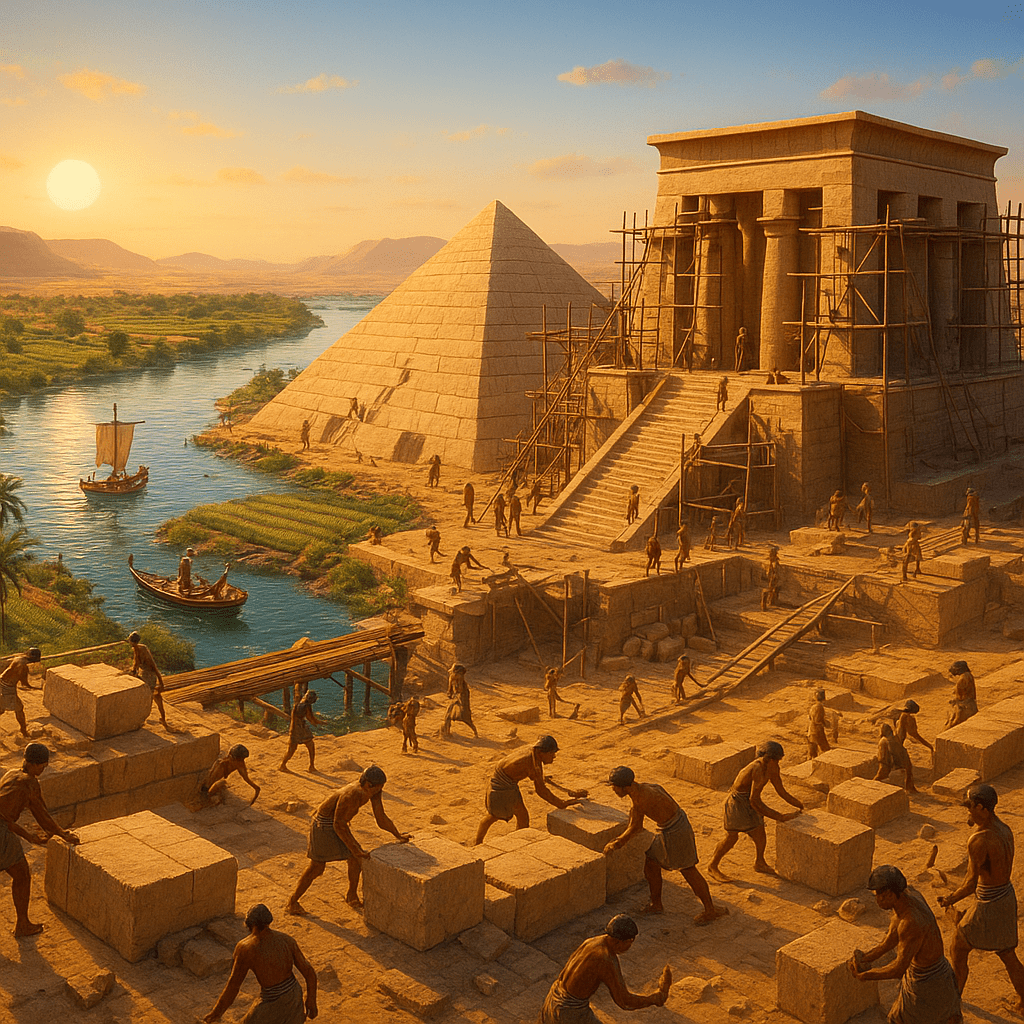
The Nile’s northward flow and the prevailing southward winds created an unusual transportation system. Boats could drift downstream with the current and sail upstream using the wind. This natural transportation network connected distant settlements and encouraged trade, communication, and political unity. Geography itself helped integrate the region long before modern roads or railways existed.
The river also acted as a climatic stabilizer. Access to dependable freshwater reduced the risks associated with drought and environmental uncertainty. While other regions often experienced severe fluctuations in agricultural productivity, the Nile’s predictable flood cycle provided a relatively stable ecological foundation. This reliability became one of the key environmental advantages that supported long-term societal development.
How the Nile Shaped Human Civilization
Because agriculture was possible along the Nile, food surpluses became common. Farmers could produce more grain than their families needed for immediate survival. These surpluses allowed some people to specialize in other occupations such as administration, construction, metalworking, trade, and religious activities. The emergence of specialized labor was one of the first steps toward complex civilization.
The concentration of fertile land along a narrow river valley encouraged political centralization. Unlike regions where populations were scattered across broad landscapes, communities along the Nile were naturally connected. Over time, local settlements became increasingly integrated, eventually leading to the formation of one of the world’s earliest unified states: Ancient Egypt. Geography made political unification easier because the river served as a natural communication corridor.
The Nile also influenced technological innovation. Egyptians developed irrigation systems, canals, water-management techniques, and agricultural calendars based on the river’s behavior. Observing flood patterns required careful record-keeping and encouraged advances in mathematics, surveying, and administration. Many practical sciences emerged from the need to manage the river effectively.
Religion and culture were deeply connected to the Nile. The annual flood appeared almost miraculous, transforming dry land into fertile farmland. As a result, the river became associated with divine power and cosmic order. Numerous religious beliefs, rituals, and myths reflected the importance of water, fertility, and renewal. For many Egyptians, the river was not merely a natural feature but a sacred force sustaining all life.
Economic development also depended heavily on the Nile. Boats transported grain, stone, timber, luxury goods, and people between distant settlements. Trade flourished because moving goods by water was far more efficient than transporting them across desert terrain. The river effectively functioned as the main economic artery of Egyptian civilization.
The construction of monumental architecture was indirectly linked to the Nile as well. Massive projects such as temples, palaces, and pyramids required large populations, organized governments, and agricultural surpluses. Without the reliable food production enabled by the river, such ambitious projects would have been nearly impossible. The famous monuments of Egypt were, in many ways, products of the Nile’s environmental generosity.
The Nile also provided a degree of security. Deserts on either side of the valley formed natural barriers against invasion. While not impenetrable, these barriers helped protect Egypt from many external threats. Combined with the river’s internal transportation network, this geographic setting allowed Egyptian civilization to develop with remarkable continuity over centuries.
Even after the decline of the pharaohs, the Nile remained central to regional development. Successive empires, including the Roman Empire, valued Egypt largely because of the agricultural productivity supported by the river. Egyptian grain fed populations throughout the Mediterranean world, demonstrating that the Nile’s influence extended far beyond its immediate surroundings.
Today, the Nile continues to support tens of millions of people. Modern dams, irrigation systems, and cities have altered its natural dynamics, but the fundamental relationship remains the same. Population centers, agriculture, industry, and transportation still cluster around the river much as they did thousands of years ago. The environmental foundations established by the Nile continue to shape human activity in the twenty-first century.
The Nile River demonstrates one of history’s most important geographical lessons: civilizations do not emerge independently of their environment. The river’s seasonal floods, fertile soils, transportation advantages, and ecological stability created conditions that allowed human societies to flourish in the middle of an otherwise inhospitable desert.
Ancient Egypt was not simply built beside the Nile—it was built because of the Nile. The river influenced where people lived, how they farmed, how they traded, how they governed themselves, and even how they understood the universe. When we look at the pyramids, temples, and achievements of Egyptian civilization, we are also seeing the long-term consequences of a river’s natural dynamics.
In this sense, the Nile is more than a river. It is a reminder that the shape of the Earth often becomes the shape of human history.


Leave a Reply