
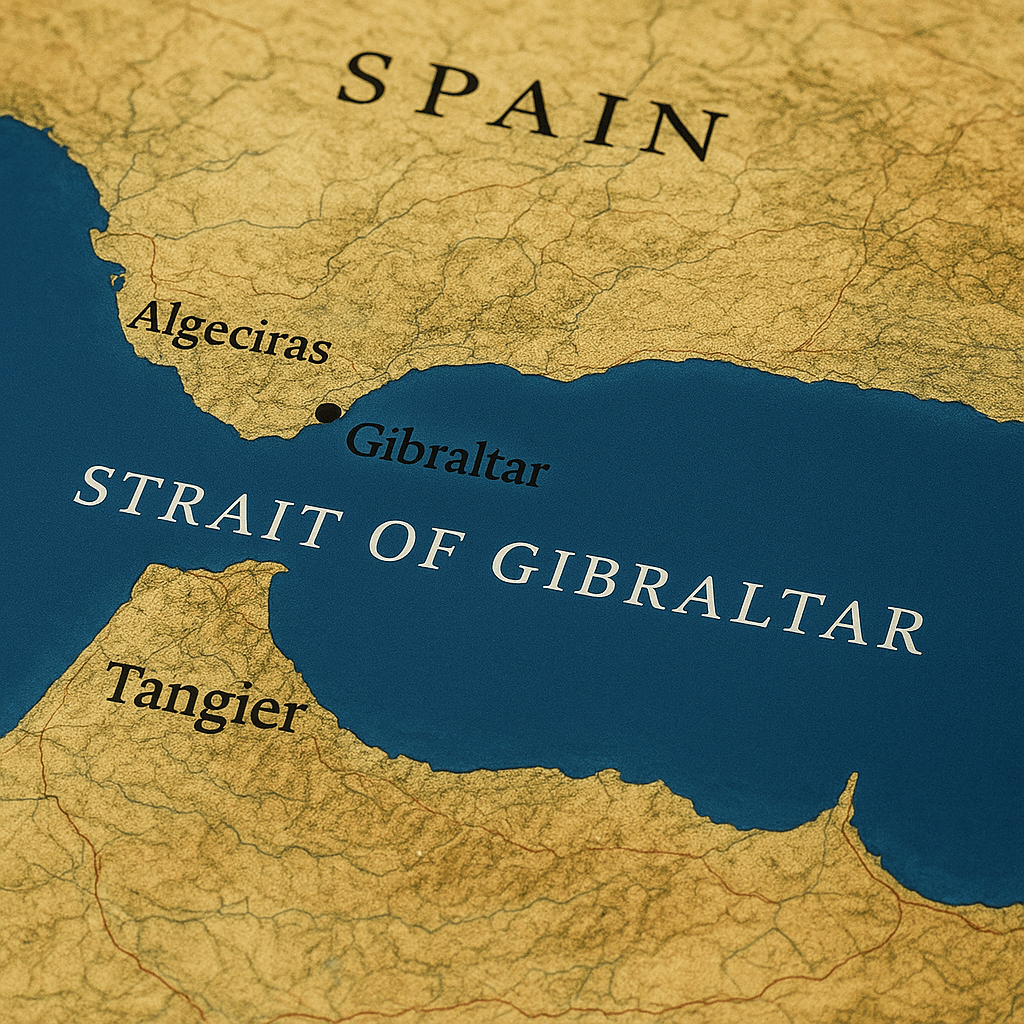
The Strait of Gibraltar is one of the world’s most important natural gateways. It connects the Atlantic Ocean with the Mediterranean Sea and separates Europe from Africa at a distance of only about 13 kilometers at its narrowest point.
Its importance comes from a simple geographical fact: whoever moves between the Mediterranean and the Atlantic must pass through this narrow corridor. That made the strait a meeting point, a barrier, a trade route, and a strategic military chokepoint.
Geological and Natural Background
The strait lies between southern Spain and northern Morocco, with the Rock of Gibraltar on the European side. It is relatively narrow and shallow compared with the open ocean, acting like a natural doorway between two very different maritime worlds.
Its waters also create a special exchange system: less salty Atlantic water flows into the Mediterranean near the surface, while saltier Mediterranean water flows outward at depth. This happens because the Mediterranean loses large amounts of water through evaporation.
Environmental Influence
Because the strait funnels wind and water through a narrow passage, it shaped navigation. Sailors had to understand currents, winds, and seasonal conditions. The geography did not simply “allow” movement; it controlled when and how movement was possible.
This made the strait both a bridge and a gate. It connected two seas, but its narrowness also made passage observable, taxable, and militarily controllable.
Influence on Human Civilization
For ancient peoples, the Strait of Gibraltar marked the edge of the known Mediterranean world. The Greeks associated the area with the “Pillars of Hercules,” a symbolic boundary between the familiar inland sea and the vast Atlantic beyond.
For Phoenicians, Carthaginians, Romans, Muslims, Iberian kingdoms, and later European empires, the strait became a route of expansion. Trade, migration, conquest, and cultural exchange passed through it. North Africa and Iberia were never completely separate worlds because geography placed them face to face.
The Muslim conquest of Iberia in 711 also shows the strait’s historical power. Its narrowness made a major military crossing possible, helping create centuries of Islamic rule and cultural exchange in al-Andalus.
Economic, Political, and Cultural Impact
Economically, the strait concentrated maritime trade. Goods from the Mediterranean could move toward the Atlantic, northern Europe, West Africa, and later the Americas. In the modern era, it remains part of major shipping routes linking the Atlantic, Mediterranean, Suez route, and global trade networks. UNCTAD continues to emphasize how vulnerable maritime trade is to disruption at chokepoints and rerouted shipping corridors.
Politically, the strait made Gibraltar valuable to Britain, Spain, Morocco, and wider NATO strategy. Control of Gibraltar gives strategic visibility over traffic entering and leaving the Mediterranean. That is why the area remains geopolitically sensitive today.
Culturally, the strait helped make the western Mediterranean a zone of mixture. Arabic, Berber, Latin, Christian, Jewish, and later European imperial influences crossed this waterway. Its geography encouraged contact even when politics created borders.
Modern Significance
Today, the Strait of Gibraltar remains a key maritime chokepoint. Nearby ports such as Algeciras and Tanger Med benefit from their position near this gateway. Tanger Med, located on the Moroccan side, has become one of Africa’s most important container ports and has gained importance as shipping routes shift during Red Sea and Middle East disruptions.
The strait also matters for migration, security, tourism, energy links, and naval movement. It is not just a line between continents; it is one of the places where Europe, Africa, the Atlantic, and the Mediterranean physically meet.
The Strait of Gibraltar shaped civilization because it compressed movement into a narrow space. Geography created a chokepoint; the chokepoint created trade, military strategy, cultural contact, and political rivalry.
In this sense, the Strait of Gibraltar shows how a small opening in the Earth’s surface can influence empires, economies, religions, and the modern global order.


Leave a Reply