
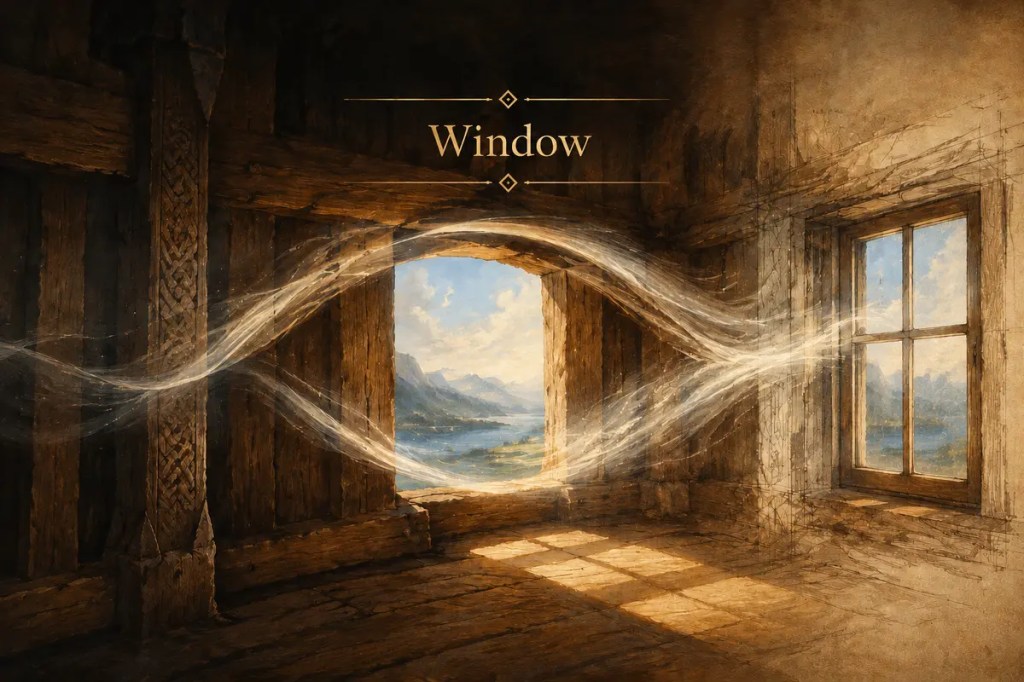
The word window names one of the most ordinary parts of a building: an opening that lets us see out and allows light or air to enter. Yet its history preserves a vivid image from the language of medieval Scandinavia. Before a window was associated with glass, it was imagined as the “eye” of a house—an opening through which the wind could pass.
1. The Old Norse “Wind’s Eye”
Window entered Middle English from the Old Norse word vindauga. It combined vindr, meaning “wind,” with auga, meaning “eye.” The compound therefore meant “wind’s eye” or “wind-eye”: an opening in a wall or roof through which air and light could enter. English adopted the word around the beginning of the thirteenth century, during a period when contact with Scandinavian languages had already left a deep mark on everyday English vocabulary.
2. From an Opening to a Glazed Frame
Earlier English had its own descriptive words, including Old English ēagþyrel, literally “eye-hole,” and ēagduru, “eye-door.” The Norse-derived window eventually replaced them. At first, the word referred primarily to an opening that admitted air and light, not necessarily to a pane of glass. As glass became more common in buildings, the meaning expanded to include the framed and glazed structure familiar today.
3. The Modern English Meaning
Today, a window can be a physical opening in a building or vehicle, but the word has also become a powerful metaphor. A “window into” a subject offers insight, while a “window of opportunity” is a limited period in which action is possible. In computing, a window is a framed area of a screen in which a program or document appears. These modern uses preserve the old central idea: a window creates an opening between one space and another.
The journey of window runs from an Old Norse “wind’s eye” to glass panes, vehicle openings, opportunities, and digital screens. The materials and technologies changed, but the image endured: a window is an opening through which the world beyond becomes visible.


Leave a Reply