
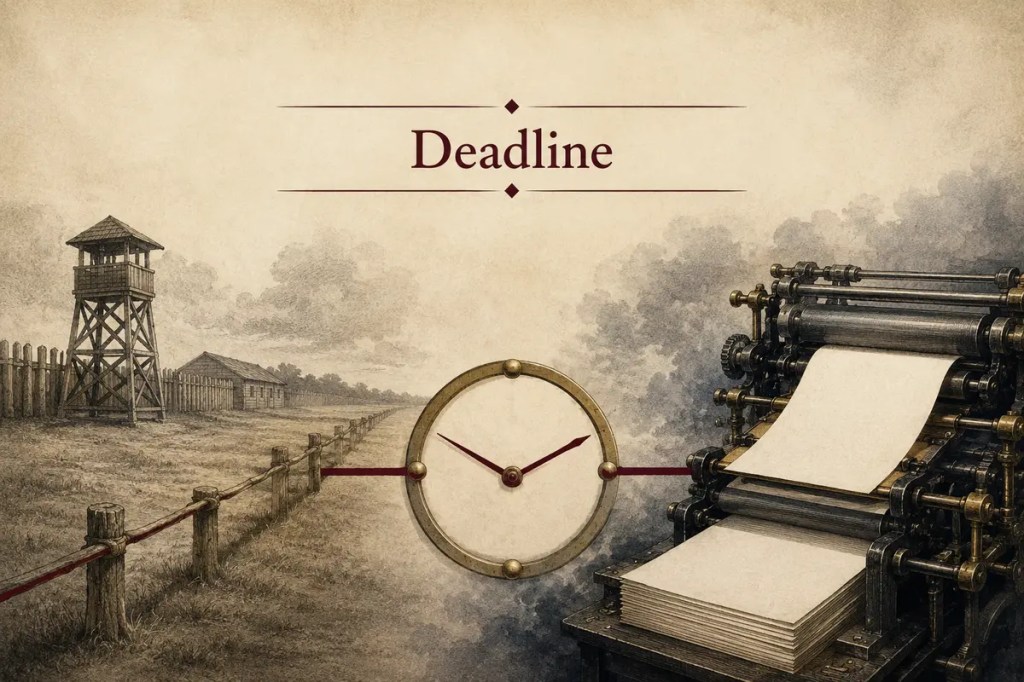
The word deadline is now part of ordinary life. A student has a deadline for an essay, a journalist for an article, and a company for a project. The word sounds dramatic for a date on a calendar, but its history explains that severity. Before a deadline marked the last acceptable moment, a “dead line” could mark a boundary that carried the threat of death.
1. A Line That Could Mean Death
During the American Civil War, dead line was used for a boundary inside or around a military prison that captives crossed at the risk of being shot. Prisoners’ diaries record the expression in 1863, and it became especially associated with the brutal conditions of wartime prison camps. In this earliest well-documented sense, the two parts of the compound were grimly literal: it was a line beyond which death might follow.
2. From a Physical Boundary to a Time Limit
After the Civil War, the prison meaning became uncommon, but the image of an uncrossable boundary survived. By 1919, American newspapers were using deadline for the absolute last moment at which copy or other material could be accepted for publication. The boundary had moved from space to time: cross it, and the work would miss the press rather than meet a bullet.
3. The Modern English Meaning
Today, a deadline is a date or time by which something must be completed, submitted, paid, or decided. The word has spread far beyond publishing into education, law, government, business, and daily planning. Expressions such as “meet a deadline,” “miss a deadline,” and “work under a deadline” preserve the feeling of a firm boundary, even when the consequences are merely inconvenience, delay, or a lost opportunity.
The journey of deadline runs from a dangerous line in a wartime prison to the final minute before a task is due. Its physical boundary became a temporal one, but the emotional force remained. A modern deadline does not usually threaten life, yet the word still makes time feel like a line that cannot be crossed without consequence.
 Intellesia
Leave a comment