
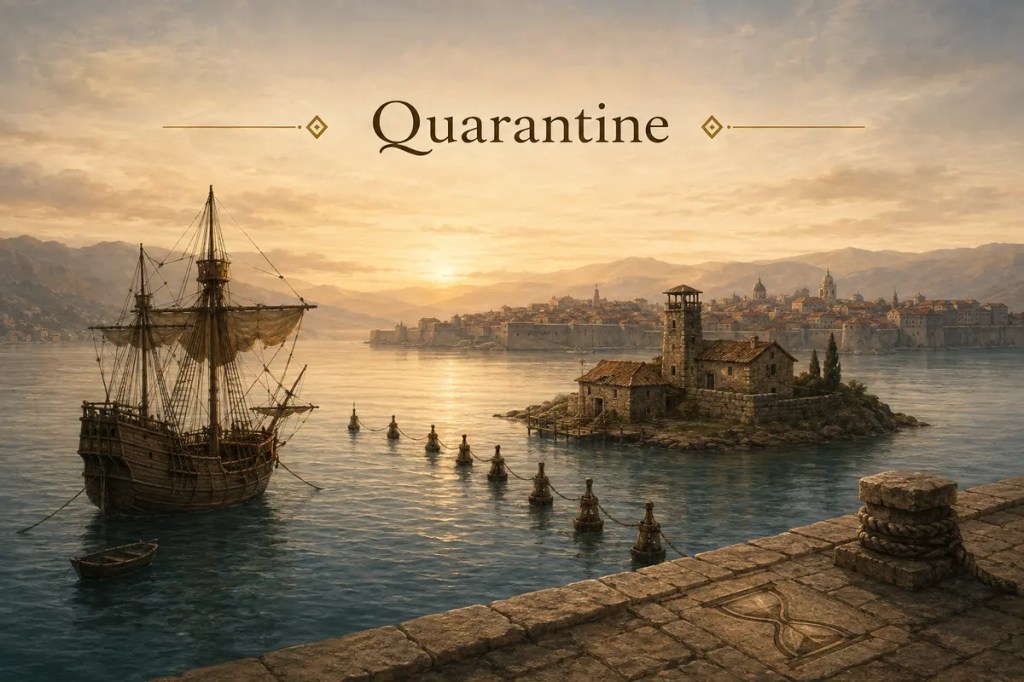
The word quarantine became familiar around the world during modern disease outbreaks, but the number hidden inside it is much older. The word began as a period of forty days, shaped by medieval port cities trying to protect themselves from plague carried by ships, travelers, and cargo.
1. Forty Days Inside the Word
Quarantine comes from Italian quarantena, meaning a period of forty days. The word is related to Italian quaranta, “forty,” and ultimately to Latin quadraginta. Early French quarantaine also referred to a forty-day period and helped shape the form that entered English.
The number forty already carried religious and legal associations in medieval Europe, including periods of fasting, penance, and prescribed waiting. In maritime health practice, however, forty days acquired a particularly practical meaning: time spent apart before people and goods could safely enter a community.
2. From Plague Ships to Public Health
During the plague epidemics of the late Middle Ages, Mediterranean ports developed rules to separate arrivals from infected places. Ragusa, now Dubrovnik, imposed an early thirty-day waiting period in 1377. Other systems later used forty days, and ships approaching Venice from suspect ports could be required to remain at anchor before passengers and cargo came ashore.
The practice joined a word for “forty days” to a system of disease control. Over the following centuries, quarantine stations, islands, inspection offices, and port regulations became part of organized public health. The fixed number eventually became less important than the principle of separating possible exposure from the wider population.
3. Quarantine in Modern English
Today, quarantine is both a noun and a verb. A person, animal, ship, plant, or product may be placed in quarantine, and authorities may quarantine something to prevent a possible disease or pest from spreading. The duration is determined by the particular risk, not automatically by the word’s original forty days.
In precise public-health usage, quarantine generally restricts people who may have been exposed but are not yet known to be ill. Isolation separates those who are already sick or infected. Everyday speech often mixes the two terms, but their distinction preserves two different stages of prevention.
Quarantine carries a medieval number into modern science. A word that once measured forty anxious days outside a harbor now names a flexible public-health measure—one built on the enduring idea that distance and time can interrupt the path of disease.


Leave a Reply