
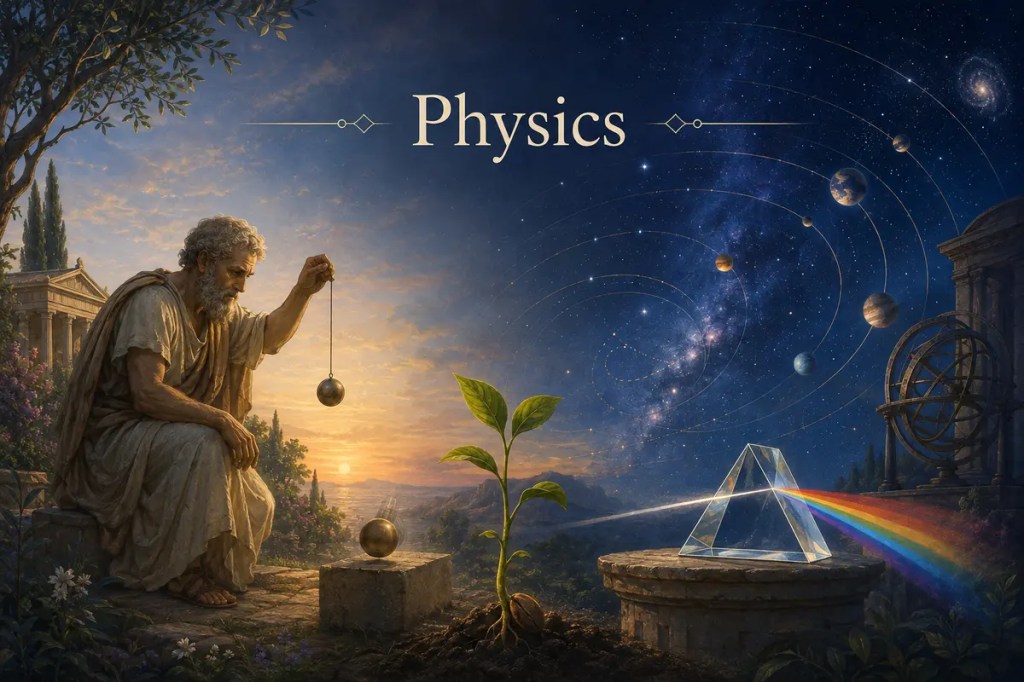
The word physics now brings to mind equations, forces, atoms, and galaxies. Its origin, however, is broader and more alive. It reaches back to a Greek word for nature that was connected with growth and coming into being—the changing world that early thinkers tried to understand without relying only on myth.
1. From Physis to “Natural Things”
Physics ultimately comes from the Ancient Greek noun physis, usually translated as “nature.” Earlier senses of the word were associated with birth, growth, emergence, and the way something develops according to its own character. Nature was not merely scenery; it was the process by which things arise and change.
The related Greek expression ta physika meant “the natural things.” It became the collective title for Aristotle’s writings about nature, motion, change, place, time, and causes. Latin adopted the form physica, and later European languages inherited words built from the same family.
2. When Physics Meant Natural Philosophy
When the word entered English, it could refer broadly to natural science rather than to one sharply defined discipline. The study of living bodies, medicine, astronomy, motion, matter, and the structure of the world all belonged to overlapping traditions of natural philosophy.
During the scientific revolution and the centuries that followed, observation, experiment, and mathematics transformed the field. Subjects gradually separated into disciplines such as chemistry, biology, and medicine. Physics narrowed toward the fundamental behavior of matter, motion, forces, heat, light, electricity, and energy.
3. Physics in Modern English
Today, physics is the science that seeks general laws governing matter, energy, space, time, and their interactions. Its branches range from mechanics and thermodynamics to electromagnetism, quantum physics, relativity, particle physics, and cosmology.
Although the word ends in -s, physics normally takes a singular verb: “Physics is difficult,” not “Physics are difficult.” Related words retain the old connection to nature and material existence: a physicist studies physics, while physical can mean bodily, material, or governed by natural laws.
Physics began as a name for the study of nature in its widest sense. As knowledge divided into specialized sciences, the word became narrower, yet its oldest question remains: how do the things of nature come into being, move, change, and hold together?
 Intellesia
Leave a comment