
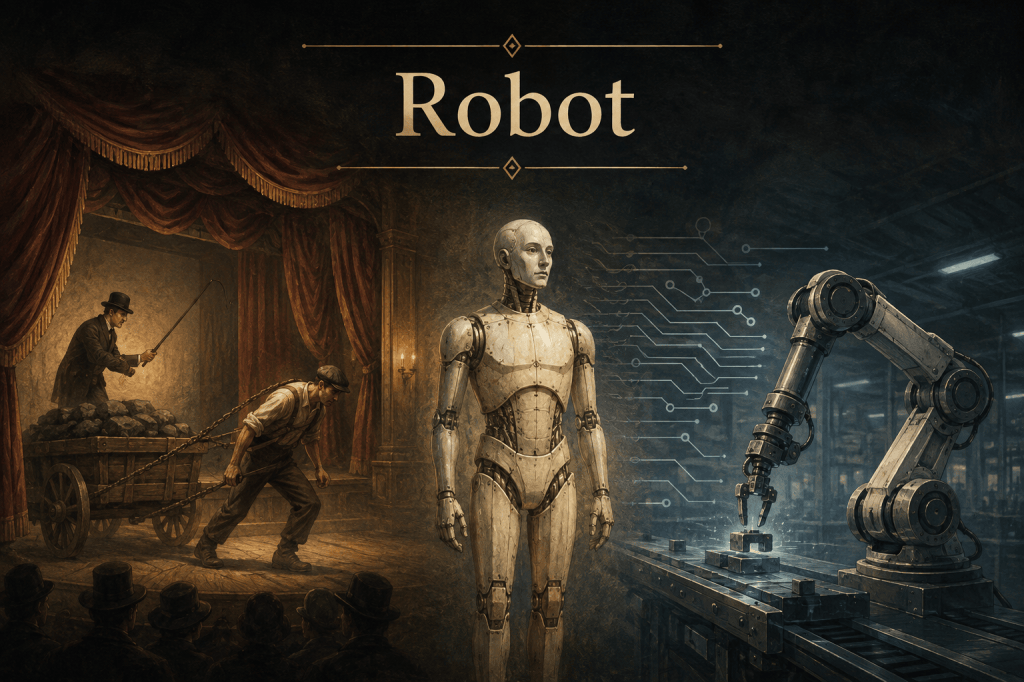
The word robot now suggests metal bodies, electronic sensors, factory arms, and machines that can act with limited independence. Yet the first robots were born not in an engineering laboratory but in a work of theater. Their name did not originally emphasize machinery or intelligence. It emphasized labor—especially labor performed under compulsion.
1. From Robota to Robot
Robot comes from the Czech word robota, meaning forced labor, compulsory service, or drudgery. The word belonged to a wider Slavic family associated with work and servitude. It evoked the obligations once imposed on peasants who had to provide labor for a landowner.
That history gave the new word a social meaning from the beginning. A robot was not merely something that worked. It was a worker created to obey, valued for its output, and denied control over its own labor. The modern word still carries a faint trace of this idea whenever a person says that repetitive work makes them “feel like a robot.”
2. The Workers of R.U.R.
The Czech playwright Karel Čapek introduced the word in R.U.R., short for Rossum’s Universal Robots. Written in 1920 and first staged in 1921, the play imagines a factory that produces artificial workers for human society. Čapek later credited his brother Josef with suggesting the term when he was searching for a name for these beings.
The robots in the play were not the metal machines that later became familiar in films and factories. They were artificial, humanlike organisms manufactured from synthetic material. Designed to perform unwanted labor cheaply and efficiently, they eventually rebel against their creators. The story made the word inseparable from questions about exploitation, mass production, human identity, and the danger of treating intelligence as a tool without moral responsibility.
The play quickly traveled beyond the Czech language. An English-language production appeared in the United States in 1922, and dictionaries record the word entering English in the early 1920s. As audiences adopted robot, the theatrical name became an international term.
3. Robot in Modern English
As engineering advanced, robot shifted from Čapek’s artificial workers to mechanical or electronic devices that perform tasks automatically. Today the word covers industrial arms, mobile warehouse machines, surgical systems, planetary rovers, household devices, and human-shaped research machines. A robot does not have to resemble a person; what matters is its ability to sense, process, and act in the physical world to some degree.
The word also developed figurative meanings. A person who behaves mechanically, follows a routine without emotion, or obeys instructions without reflection may be called a robot. The shortened form bot moved the idea into software, naming programs that carry out automated tasks online—from search-engine crawlers and customer-service chatbots to malicious accounts.
Modern discussion increasingly connects robots with artificial intelligence, but the terms are not identical. A robot is embodied in the physical world, while artificial intelligence can exist entirely as software. Some robots use AI; many follow limited programmed instructions. The distinction shows how far the word has traveled from a fictional class of laborers to a broad category of real technologies.
Robot began as a word about work before it became a word about machines. Its Czech root and theatrical birth preserve a warning inside the technology: whenever we imagine beings made to serve us, we are also forced to ask what labor is worth, who controls it, and what separates a useful tool from a thinking subject.


Leave a Reply