
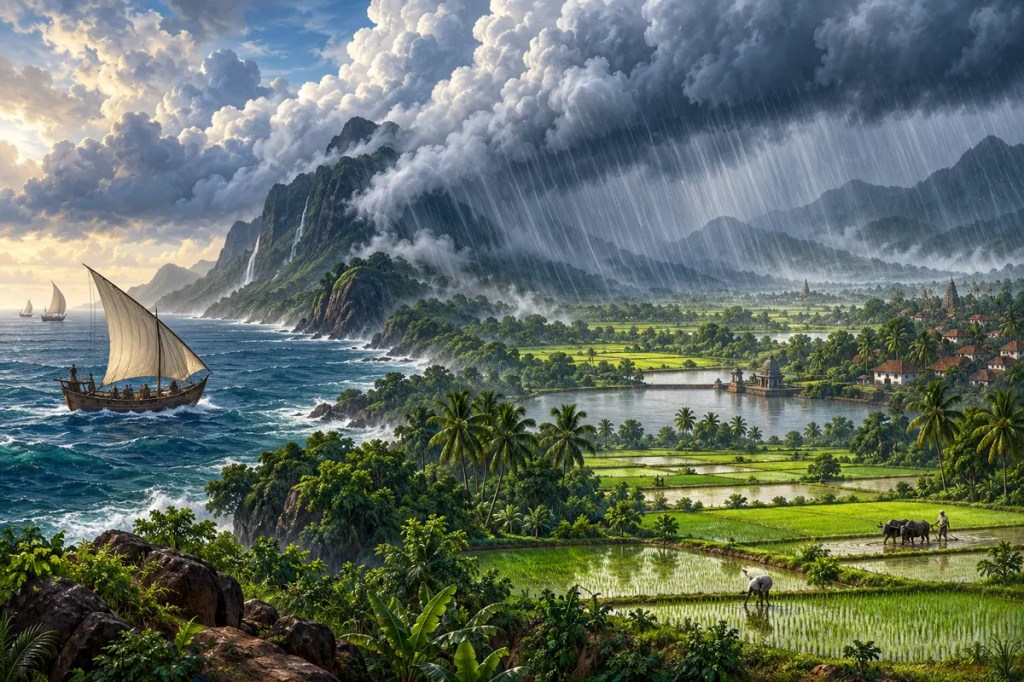
The Indian monsoon is often described as a season of rain, but it is better understood as a vast annual reorganization of wind, heat, moisture, and human activity. Each year, its arrival changes the color of the land, the level of reservoirs, the rhythm of planting, and the prospects of hundreds of millions of people. For centuries, the same reversing winds also carried ships across the Indian Ocean, linking distant ports into one of history’s great commercial worlds.
1. An Atmospheric System That Changes Direction
The word monsoon refers to a seasonal reversal of prevailing winds, not simply to heavy rainfall. During the northern summer, the Asian landmass warms more strongly than the surrounding ocean. Moist air flows inland from the Indian Ocean, rises, cools, and releases rain. The southwest monsoon normally advances across much of India from June and dominates the period through September.
Topography reshapes this circulation. The Western Ghats force moist air upward along India’s west coast, producing heavy rainfall on their windward slopes. Farther north, the Himalayas and Tibetan Plateau influence heating and circulation while forming a massive barrier that helps keep moist air over the subcontinent. The result is not one uniform rainstorm but a changing pattern of wet spells, breaks, regional contrasts, and sudden extremes.
2. Rain Rewrites the Landscape
After the dry heat of late spring, monsoon rain revives rivers, wetlands, forests, and grasslands. Water infiltrates soils and helps recharge aquifers; runoff fills tanks, lakes, dams, and river channels. Across much of South Asia, the June–September southwest monsoon supplies most of the annual rainfall and therefore governs the renewal of freshwater reserves.
The monsoon also moves earth. Intense rain erodes hillsides, transports sediment, nourishes floodplains, and reshapes riverbanks and deltas. These processes create fertile land but can also trigger landslides, flash floods, and destructive river migration. The geography of the subcontinent is repeatedly renewed—and sometimes violently rearranged—by seasonal water.
3. Agriculture Organized Around Arrival
The timing of the monsoon helped organize India’s agricultural calendar. Farmers traditionally prepared fields while watching clouds, winds, insects, and local signs of approaching rain. The onset of reliable moisture allowed the sowing of kharif crops such as rice, millet, cotton, pulses, and oilseeds. Harvests depended not only on the total amount of rain but also on when it arrived, how evenly it was distributed, and whether long dry breaks interrupted growth.
Irrigation, dams, pumps, crop insurance, improved forecasts, and groundwater have reduced some dependence on direct rainfall, but they have not removed it. Reservoir storage, electricity demand, fodder availability, rural employment, and food prices still respond to the strength and distribution of the monsoon. A national economy with modern industries continues to watch the sky.
4. Water Shaped Settlement and Power
Because rain is concentrated in part of the year, communities developed ways to capture and store it. Wells, stepwells, village tanks, canals, embankments, and terraced fields turned seasonal abundance into water that could last through dry months. These systems reflected local rainfall, geology, soils, and political organization.
Control of water could strengthen kingdoms and states. Rulers sponsored reservoirs and canals, collected revenue from irrigated land, and claimed legitimacy by protecting cultivation. At the same time, maintenance often depended on village institutions and shared labor. Monsoon geography therefore shaped relationships between households, communities, and governments as much as it shaped crops.
5. The Wind Roads of the Indian Ocean
The monsoon created a maritime clock. Winds over the northern Indian Ocean reverse direction with the seasons, allowing sailors to plan outward and return voyages. Merchants learned when to cross the Arabian Sea and when to wait in port for the winds to change. The result was not a single route but a network connecting East Africa, Arabia, India, Sri Lanka, Southeast Asia, and beyond.
Spices, textiles, grain, ceramics, metals, and precious goods moved with these winds. So did languages, religious ideas, artistic forms, technologies, and communities. Ports became cosmopolitan places because the monsoon sometimes required merchants to remain for months before sailing home. Seasonal atmosphere became infrastructure: the wind itself helped organize commerce and cultural exchange.
6. A Season in Culture and Everyday Life
The first rains bring practical relief from heat, but they also carry emotional and cultural meaning. Poetry, painting, music, film, and popular memory portray dark clouds, peacocks, separation, reunion, longing, and renewal. Festivals and regional calendars reflect agricultural and seasonal rhythms created by rain.
Yet the monsoon is never purely romantic. Streets flood, buildings leak, transport fails, and disease risks change. Its cultural power comes from this mixture of relief and danger. It is awaited because life depends on it and feared because dependence creates vulnerability.
7. Variability in a Changing Climate
No two monsoons are identical. Rainfall varies with conditions in the Pacific and Indian oceans, including El Niño and the Indian Ocean Dipole, as well as snow cover, land temperatures, and shorter-lived weather systems. A season can appear near normal in its national total while still producing damaging drought in one region and floods in another.
Climate change adds further complexity by warming the atmosphere and oceans and increasing the potential for intense rainfall. Rapid urbanization magnifies the effects where wetlands and drainage channels have been lost. Modern resilience therefore requires seasonal forecasts, local warnings, water storage, flood-sensitive planning, drought preparation, and agricultural choices that respond to regional conditions rather than a single national average.
8. Conclusion: Civilization in a Seasonal Atmosphere
The Indian monsoon shows that civilization is shaped not only by permanent features such as mountains and rivers, but also by moving systems in the air. Its reversing winds created agricultural calendars, water institutions, trading circuits, cultural expectations, and modern forecasting systems. The monsoon does not merely pass over society each year; it has helped organize the society waiting beneath it.


Leave a Reply