
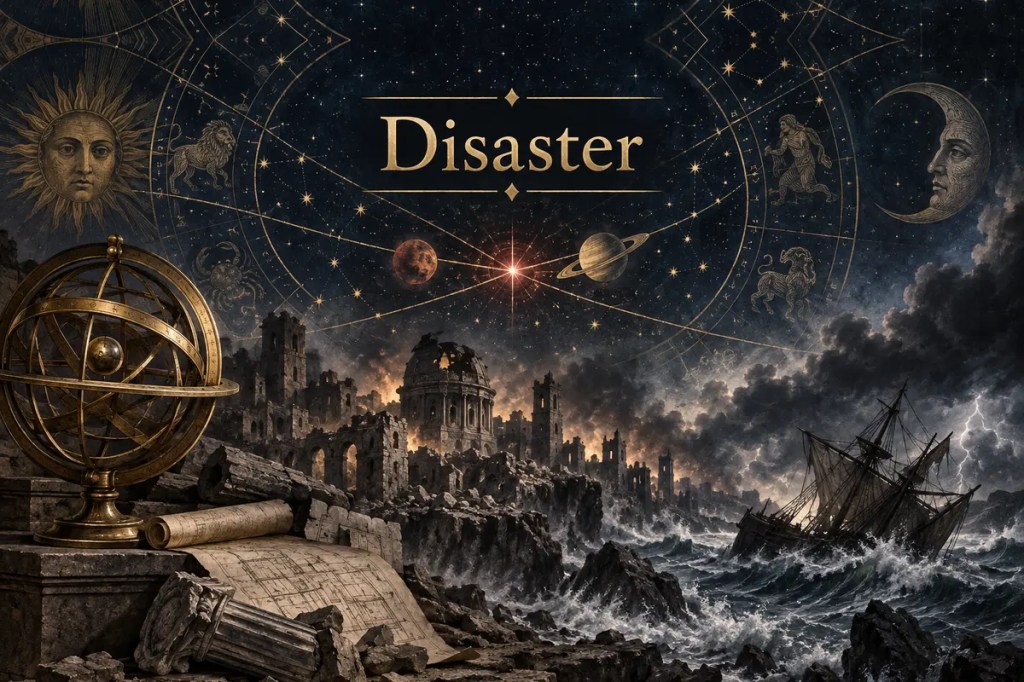
Today, a disaster is a devastating event: an earthquake, a shipwreck, a technological failure, or a plan that collapses spectacularly. Yet the word once pointed upward rather than outward. Hidden inside disaster is an old belief that human fortune could be read in the stars—and that an unfavorable sky might announce calamity below.
1. From the Stars: Disastro
English borrowed disaster in the sixteenth century through French and Italian. Its immediate ancestor was Italian disastro, formed from a negative or pejorative use of dis- and astro, “star” or “heavenly body.” Astro ultimately reaches back through Latin astrum to Greek astron, another word for a star.
The compound therefore carried the sense of being “ill-starred.” In an age when astrology was treated as a serious framework for interpreting earthly affairs, the arrangement or aspect of planets and stars could be understood as favorable or hostile. An unfavorable celestial aspect was not merely a pattern in the sky; it was imagined as a sign of misfortune waiting to unfold.
This history connects disaster with expressions such as ill-starred and star-crossed. All preserve traces of the idea that a person, voyage, kingdom, or enterprise might prosper or fail according to the heavens under which it began. The word did not originally name a flood, fire, or battle itself. It named the hostile fortune believed to stand behind such events.
2. When Fate Became Misfortune
As disaster settled into English, its focus moved from celestial cause to earthly consequence. The astrological explanation gradually weakened, while the ruinous event remained. A word for an ominous arrangement of the heavens became a word for the suffering, destruction, or failure that such an arrangement was once thought to produce.
This change reflects a familiar pattern in language: a belief can fade while its vocabulary survives. English speakers no longer need to imagine an unlucky planet when they call a fire or famine a disaster. The old cosmology has become invisible, but it still shapes the word. Every modern use carries a small fossil of the time when fate seemed written across the night sky.
The semantic range also widened. Disaster came to describe both the event and its disastrous result, from public catastrophes involving great loss to ventures ending in complete failure. The word could move easily from history and government into everyday judgment because its central idea was no longer astrology. It was a sudden or overwhelming reversal from order and hope toward damage and distress.
3. Disaster in Modern English
In modern English, disaster most strongly refers to an event that causes severe harm, destruction, or loss. It appears in phrases such as natural disaster, industrial disaster, disaster relief, and disaster recovery. These compounds treat disaster not as mysterious fate but as something whose risks can be studied, whose consequences can be reduced, and whose survivors can be helped.
The word also has an ordinary figurative life. A failed performance may be “a disaster”; a chaotic room may “look like a disaster”; a badly planned project may become “a recipe for disaster.” Such uses exaggerate for effect, but they preserve the basic movement of the older word: expectations are overturned, control disappears, and the outcome seems governed by hostile fortune.
Its adjective, disastrous, followed the same path. What once could mean ill-starred or unlucky now means ruinous, calamitous, or extremely unsuccessful. The language of the stars has receded so completely that most speakers hear only the scale of the damage—unless they pause to notice the quiet astro still shining inside the word.
Disaster began with a dark reading of the sky. Its journey from an “unfavorable star” to a destructive event shows how language can outlive the worldview that created it: the stars no longer receive the blame, but their ancient shadow remains inside the word.


Leave a Reply