
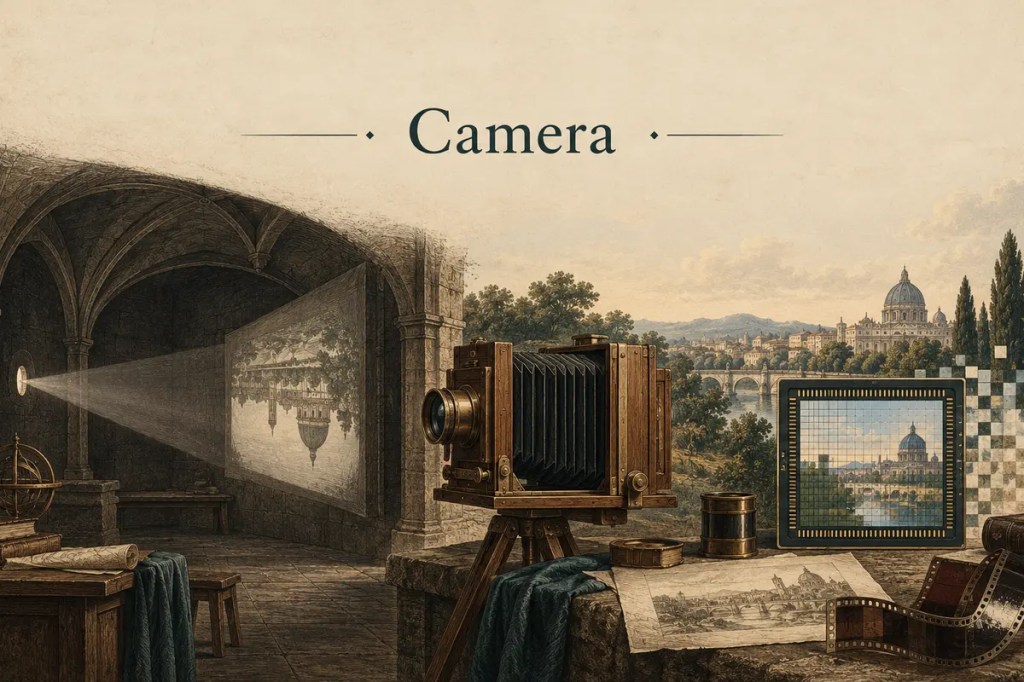
A camera now fits inside a phone, watches a doorway, guides a spacecraft, and turns an ordinary moment into a permanent image. The word, however, did not begin with photography. It began with architecture: a vaulted room whose darkness eventually taught people how light could carry the outside world indoors.
1. From a Vault to a Room
Camera comes from Latin camera, meaning a vaulted room or chamber. Latin had borrowed the word from Greek kamara, which referred to a vault, an arched covering, or a vaulted chamber. The origin of the Greek word itself is uncertain, so the reliable trail begins there rather than with a more imaginative story.
The same Latin source reached English by another route as chamber, through Old French chambre. Camera and chamber are therefore doublets: related words that entered English through different paths and developed different uses.
Early English uses of camera could still refer to a room or vaulted structure. That architectural meaning survives faintly in the legal phrase in camera, meaning that proceedings take place privately—literally, “in the chamber.”
2. The Dark Chamber That Made Images
The decisive change came through the New Latin phrase camera obscura, “dark chamber.” In its simplest form, a darkened room or box admits light through a small opening or lens. The light projects an inverted image of the outside scene onto an interior surface.
The optical principle was known long before modern photography, and camera obscuras became tools for studying vision and observing the world. Artists could use the projected image as a guide for drawing, while scientists could investigate how light travels and forms images.
During the nineteenth century, inventors combined the image-forming chamber with light-sensitive materials. The projected scene no longer had to disappear when the light changed: it could be chemically recorded. As photography developed around the 1840s, camera became the ordinary shortened name for the picture-making device.
3. Camera in Modern English
A modern camera still preserves the old idea of a chamber. Whether it uses photographic film or an electronic sensor, it is essentially a light-controlled enclosure that receives an image through an aperture and lens. The materials have changed, but the basic spatial metaphor remains.
The word expanded with new technologies: motion-picture cameras, television cameras, security cameras, webcams, phone cameras, and instruments carried by satellites and scientific probes. It now names devices that record not only visible light but, in broader technical use, other parts of the electromagnetic spectrum.
Modern expressions reveal the camera’s cultural power. To be on camera is to enter a recorded public space; to work behind the camera is to shape what others see; to be camera-shy is to resist that gaze. A word that once named a room now names one of our most influential ways of framing reality.
Camera has moved from stone vault to dark chamber, from projected light to captured memory, and from a specialized instrument to an everyday companion. Yet every camera still carries its first meaning: it is a room—however small—where light enters, an image forms, and the outside world is briefly held within.
 Intellesia
Leave a comment