
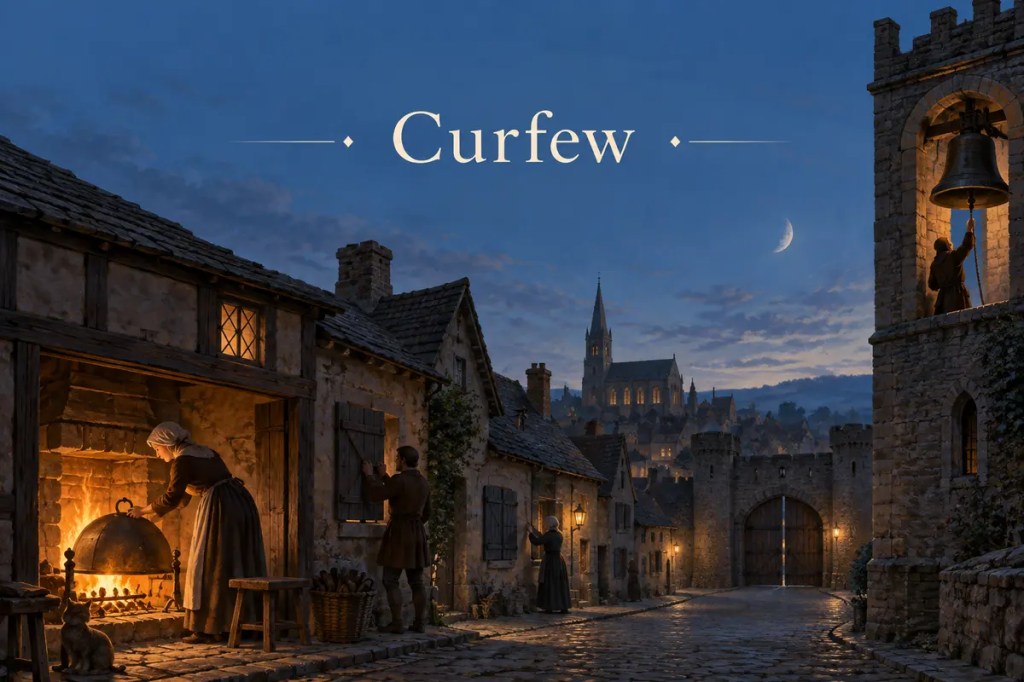
Curfew now sounds like a rule about movement: be home by a certain hour, stay indoors during an emergency, or leave a public place before night. Hidden inside the word, however, is a much older instruction about fire. Its history begins in crowded medieval settlements, where the evening bell did not merely mark time—it warned households to make their flames safe.
1. “Cover the Fire”
Curfew entered Middle English through Anglo-French forms such as coverfeu and coeverfu. The expression combined coverir, “to cover,” with feu, “fire.” Its literal sense was therefore “cover the fire.” As English speakers adapted the unfamiliar French sounds, the word passed through spellings such as curfeu before settling into its modern form.
The instruction belonged to a world of open hearths, wooden buildings, narrow streets, and limited firefighting. At a fixed evening hour, a bell could signal that fires and lights should be extinguished, covered, or safely banked for the night. The word first named this signal and the time associated with it, rather than an order that everyone must remain indoors.
Popular retellings sometimes attribute the custom entirely to William the Conqueror, but evening fire regulations and bells were not confined to a single ruler or one place. The safer historical claim is broader: medieval communities used such signals for fire prevention, the ordering of daily life, and sometimes public security.
2. From Bell to Restriction
Once the evening bell marked the end of normal activity, its meaning naturally extended beyond the hearth. Shops closed, work stopped, gates might be secured, and people were expected to withdraw from the streets. The signal that told households to cover their fires became associated with the boundary between permitted daytime life and regulated night.
Over time, English used curfew for the hour itself and then for rules imposed at that hour. By the nineteenth century, the modern sense of a restriction requiring people to remain indoors or leave public places had become established. The physical action disappeared from ordinary use, but the idea of an evening limit remained.
This semantic change is a form of metonymy: the name of a signal came to stand for the wider system of conduct announced by that signal. The bell, the hour, and the rule were closely connected in practice, so one word gradually came to name all three.
3. Curfew in Modern English
Today a government or military authority may impose a curfew during war, civil disorder, disaster, or another emergency. In that setting, the word usually refers to both the official order and the period during which movement is restricted: a city can be “under curfew,” and a curfew can “begin at midnight.”
The word also moved into ordinary domestic life. Parents may give a teenager a curfew, a residence may set a return time, and a venue may face a noise curfew. These uses are less severe than an emergency order, yet they preserve the same structure: an authority fixes an hour after which certain activity must stop.
Modern compounds and phrases show how flexible the word has become—night-time curfew, juvenile curfew, curfew violation, and curfew hours. Even when no bell rings and no flame is covered, the word still draws an invisible line across the evening.
Curfew began as a practical call to “cover the fire.” The warning bell became the name of an hour, and the hour became the name of a restriction. Every modern curfew therefore carries a faint echo of the medieval night: flames dimmed, streets quieted, and a community told that the day’s freedom of movement had reached its limit.


Leave a comment