
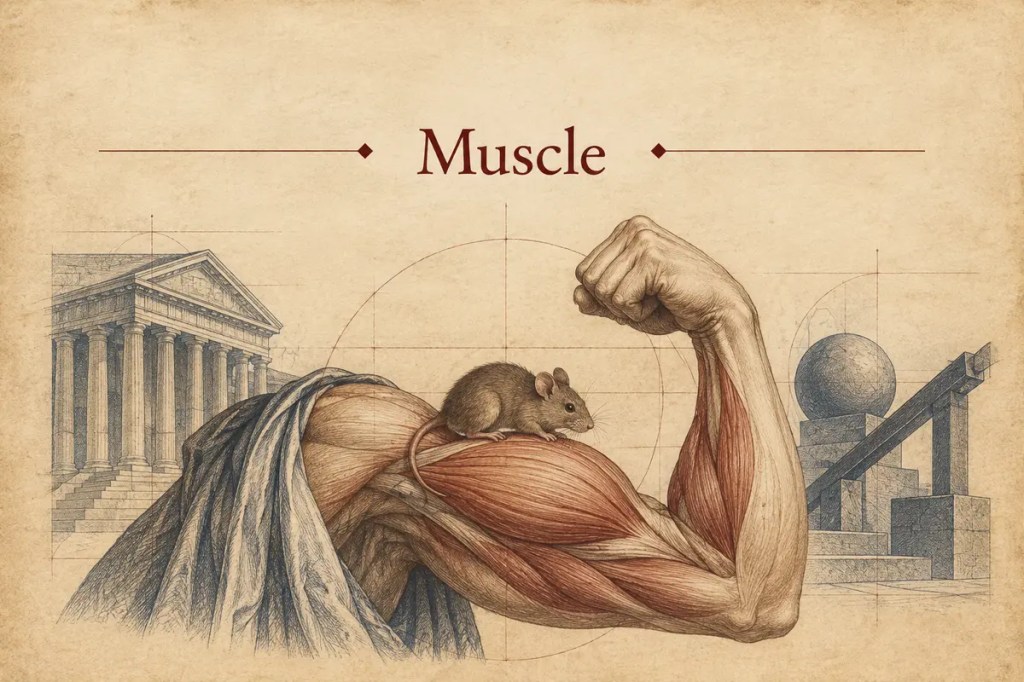
We use muscle for the tissue that moves the body, the strength needed to lift a weight, and even the influence that makes an institution powerful. Behind all these senses is an unexpectedly small animal. The English word descends from a Latin term meaning “little mouse,” preserving the ancient image of a creature seeming to move beneath the skin when a muscle contracts.
1. A Little Mouse in Latin
Muscle comes from Latin musculus, the diminutive of mus, “mouse.” Literally, musculus meant a small or little mouse. The Romans also used it for a muscle, apparently because the shape and movement of certain muscles—especially prominent muscles in the arms and legs—suggested a mouse moving under the skin.
The comparison was not confined to Latin. Ancient Greek mys could also mean both “mouse” and “muscle,” and its combining form survives in medical terms beginning with myo-, such as myology and myopathy. Across several languages, observers turned the visible movement of living tissue into an animal metaphor.
English received the word in the Middle Ages. It appears in Middle English in the late fourteenth century as a name for contractile tissue or an individual organ of the body. The original mouse image gradually disappeared from ordinary awareness, but it remained embedded in the word itself.
2. From Anatomy to Power
For centuries, muscle was primarily anatomical. It named the tissue whose contraction produces or controls movement, and it generated related words such as muscular, musculature, and intramuscular. Advances in anatomy made the term more precise without changing its basic physical reference.
By the nineteenth century, the word had developed a broader figurative sense: bodily strength or brawn. From there it could describe effective power of almost any kind. A government might possess military muscle, a company financial muscle, or a political group enough muscle to influence a decision.
American English also pushed the word toward force and coercion. Muscle could refer to a strong person employed to intimidate others, while the verb came to mean accomplishing something through physical strength or pressure. To muscle someone out is to force that person from a position; to muscle through is to advance by determined effort or brute force.
3. Muscle in Modern English
In modern English, the literal meaning remains central. A muscle is contractile tissue or an organ formed largely from that tissue, and everyday expressions speak of building muscle, pulling a muscle, or relaxing tense muscles. The word can also stand collectively for physical strength, as in having the muscle to move something heavy.
Its figurative uses treat power as if it were a body capable of exerting force. Political muscle, economic muscle, and organizational muscle describe the practical ability to produce results. To flex one’s muscles may refer to literal exercise, but it often means displaying power as a warning or demonstration.
The word also appears in compounds shaped by changing culture and technology. A muscle car emphasizes engine power and acceleration; muscle memory names the way practiced movements become easier to perform, although the learning is coordinated by the nervous system rather than stored in muscle alone. In every case, the word carries an idea of movement, force, or trained capacity.
Muscle began with an ancient visual comparison: a small mouse seeming to shift beneath the skin. From that compact image, the word expanded to name the tissue of movement, the strength of a body, the power of an organization, and the act of forcing a way forward. The mouse has vanished from view, but its motion still lives inside the word.


Leave a comment