
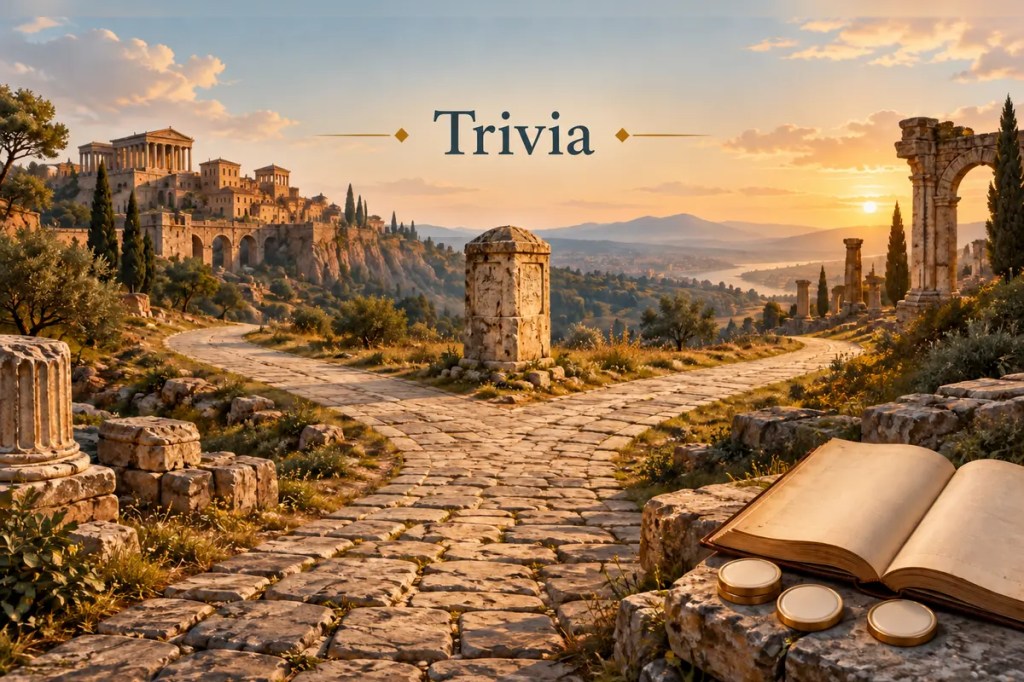
Trivia now evokes quiz nights, obscure facts, and the pleasure of knowing details that most people overlook. Yet the word began not with questions and answers, but with a physical place: a point where three roads met. Its journey from a crossroads to commonplace matters, and then to entertaining fragments of knowledge, shows how language can turn geography into judgment.
1. Three Roads Meet
The distant ancestor of trivia is the Latin noun trivium, formed from tri-, meaning “three,” and via, meaning “road” or “way.” A trivium was therefore a place where three roads came together. Its plural form was trivia.
A crossroads was open to everyone and encountered in ordinary public life. From this setting came the Latin adjective trivialis, meaning “of the crossroads,” then “public,” “common,” or “commonplace.” The semantic movement did not depend on a particular story about gossip or notices being posted at Roman intersections. The broader connection was simpler: what belonged to a place used by everyone could be regarded as familiar and ordinary.
The same root also acquired an academic life in the Middle Ages. The trivium named the first three liberal arts—grammar, rhetoric, and logic—which prepared students for the four mathematical arts of the quadrivium. This educational meaning and the classical image of three roads share the same Latin word, although the modern noun trivia developed through the idea of commonplace or minor matters.
2. From the Commonplace to the Trifling
English borrowed trivial before trivia became a familiar noun. By the late sixteenth century, trivial could describe something ordinary or widely found. It soon gained a more dismissive sense: something insignificant, trifling, or of little worth. A word connected with what was common had become a way to rank importance.
The noun trivia emerged much later. Merriam-Webster dates its first known English use to 1902, while the title of Logan Pearsall Smith’s collection Trivia helped associate the word with brief reflections on small and commonplace subjects. By the 1930s, it was being used for minor facts and pieces of information with little practical consequence.
During the mid-twentieth century, informal contests transformed those supposedly useless facts into a form of social play. Students competed to recall details from history, sport, comics, radio, and television. The board game Trivial Pursuit, released in the early 1980s, helped make the connection between trivia and question-based games internationally familiar.
3. Trivia in Modern English
Today, trivia has several closely related uses. It can mean unimportant matters, as in “administrative trivia.” It can also mean little-known facts about people, events, or specialized subjects, such as film trivia or historical trivia. Finally, it can name the game itself: people play trivia, attend a trivia night, or join a trivia team.
The word is plural in form, but modern English often treats it as a mass noun or as singular when it refers to the activity. We normally say “some interesting trivia” rather than “a trivia.” Individual items are more naturally called trivia questions, facts, or pieces of trivia.
Its tone depends on context. Calling something trivia can dismiss it as irrelevant, yet trivia games celebrate attention, memory, and curiosity. A fact may have little practical value and still reveal an unexpected connection. The word therefore carries a productive tension between insignificance and fascination.
Trivia traveled from three converging roads to the common things found in public life, then to the small facts gathered for curiosity and play. What once meant ordinary knowledge now reminds us that even minor details can lead the mind somewhere unexpected.


Leave a comment