
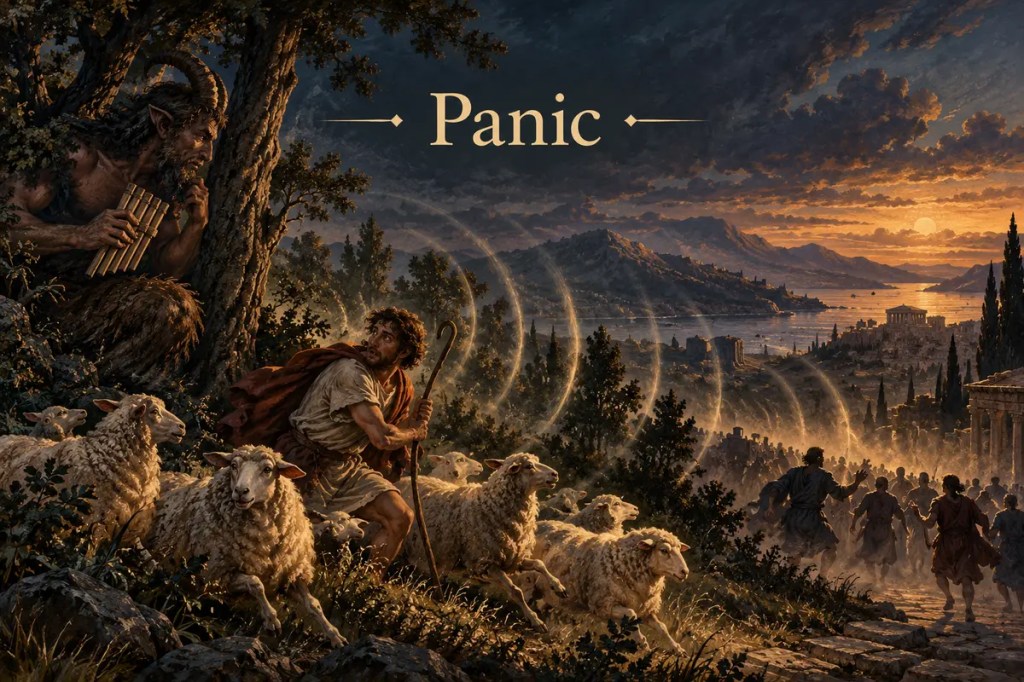
Panic feels like a word made from the sensation it describes: short, sharp, and suddenly difficult to control. Yet its history begins not in modern psychology or disaster reporting, but in the ancient Greek countryside. The word carries the name of Pan, the god whose unseen presence was believed to turn an ordinary silence into collective, unreasoning fear.
1. “Of Pan”
The English word panic ultimately comes from Greek panikos, meaning “of Pan” or “pertaining to Pan.” Pan was associated with pastures, shepherds, flocks, woodland, and wild places. Greek panikon deima—literally a fear connected with Pan—described a sudden terror whose cause was hidden or difficult to explain.
In stories about Pan, a cry or mysterious sound in a lonely landscape could frighten people, animals, or entire groups into flight. The historical word does not mean that every frightened person believed Pan was physically present. Rather, his name became a compact cultural explanation for fear that arrived abruptly, spread quickly, and seemed greater than its visible cause.
Greek panikos passed into French as panique. English borrowed it in the late sixteenth century, first as an adjective in expressions such as panic fear or panic terror. The noun followed, allowing the supernatural quality once attributed to Pan to become the name of the emotional state itself.
2. From Divine Fright to Collective Fear
As panic became established in English, its meaning broadened beyond mythology. It described overpowering fear that could move through a crowd without careful reasoning. That collective sense preserved an important part of the older image: one alarming sound or movement could pass from person to person as rapidly as fear spreading through a startled flock.
By the eighteenth century, the word had entered financial language. A panic could be a wave of apprehension that drove investors or depositors to sell assets or demand money at the same time. Nothing supernatural was required. The market itself behaved like a frightened crowd, with each person’s defensive action increasing the danger perceived by everyone else.
The verb developed later, first meaning to throw someone into panic and then to lose one’s own composure. English also formed panicky, panic-stricken, and eventually many compounds. The word travelled easily because it named both a private feeling and a social process: fear within one mind could become fear between many minds.
3. Panic in Modern English
Today, panic can be a noun, a verb, or an adjective. Someone may feel panic, panic when a plan fails, or make a panic decision. Common expressions such as panic buying, panic selling, and panic button apply the word to moments when urgent reaction replaces measured judgment.
Modern medicine gives panic attack a more specific meaning: a sudden wave of intense fear or discomfort that may occur even when no clear danger is present. Not every ordinary moment of alarm is a panic attack, and experiencing one does not automatically mean that a person has panic disorder. The clinical use is precise, but it still echoes the word’s ancient association with fear that seems to arrive without warning.
The word is often used loosely in news and conversation, sometimes exaggerating manageable anxiety into chaos. Its history reminds us why that exaggeration is powerful. Panic has always suggested not merely fear, but fear that overwhelms explanation, passes rapidly through a group, or makes immediate action feel unavoidable.
Panic began as fear “of Pan,” an invisible disturbance imagined in the ancient countryside. As the god faded from everyday belief, his sudden terror remained in the language—moving from myth to crowds, markets, medicine, and every moment when fear outruns reason.


Leave a comment