
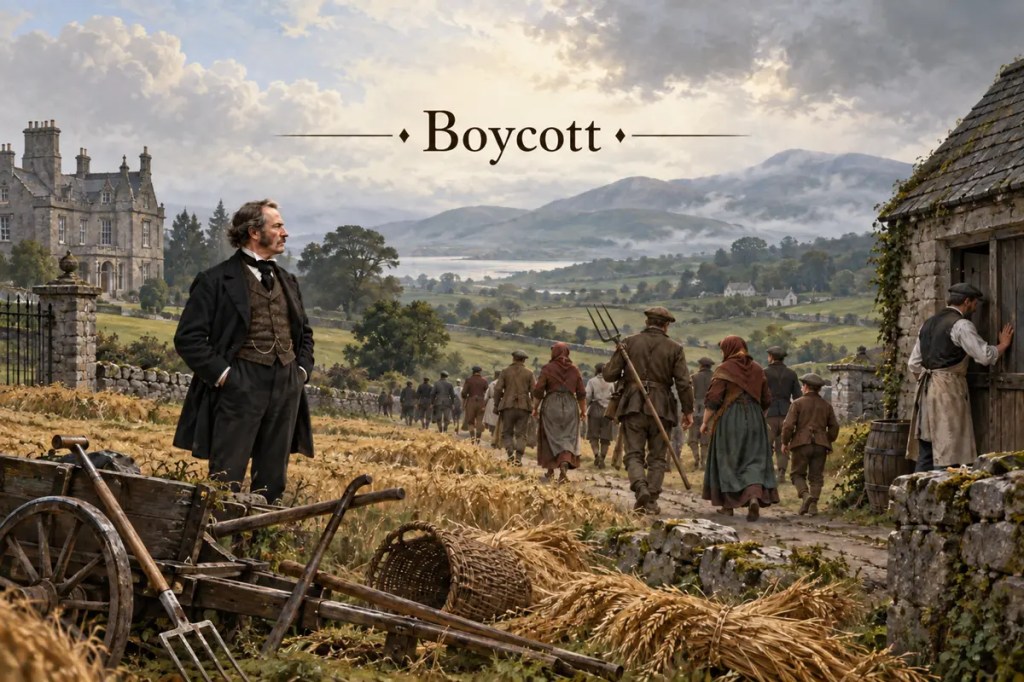
Most words arrive quietly, worn smooth by centuries of speech. Boycott is different: we can point to the person, the place, and even the year in which a surname became a public weapon. In 1880, an English land agent in western Ireland found himself cut off from workers, shops, neighbours, and ordinary social life. His name soon escaped the man and entered the language as a word for organized refusal.
1. A Surname Becomes a Verb
The word comes directly from Charles Cunningham Boycott, an English-born land agent working for the Earl of Erne near Lough Mask in County Mayo, Ireland. Unlike a word assembled from older Greek, Latin, or Germanic roots, boycott is an eponym: a common word formed from a person’s name.
Merriam-Webster dates its first known English use to 1880 and identifies Boycott as the agent who was ostracized after refusing to reduce rents. The speed is striking. Within weeks, a proper noun with a capital letter was being used as a verb for the collective action taken against him; it also developed a noun sense for the campaign itself.
2. Ireland’s Land War and the Power of Isolation
The new word emerged during the Irish Land War, when tenant farmers and the Irish National Land League challenged high rents, insecure tenure, and eviction. After a poor harvest and severe economic hardship, tenants on the estate sought a rent reduction. The request was not accepted, and Boycott moved to serve notices against tenants who had fallen into arrears.
The response was neither a conventional battle nor an individual refusal. Labourers and domestic servants stopped working for Boycott, while local merchants and neighbours declined to deal with him. The aim was to isolate the agent socially and economically until maintaining the existing arrangement became impractical. History Ireland describes how the local community joined the campaign and how the episode became part of the wider struggle over Irish land.
The press carried the affair far beyond County Mayo. Another History Ireland account notes that the new use appeared in print in 1880 and was associated with Father John O’Malley, who reportedly proposed Boycott’s surname as a concise label for the tactic. Whether spoken first in exactly that moment is difficult to prove, but the documentary record is clear about the larger transformation: the name and the method became inseparable.
3. From One Estate to a Global Tactic
In modern English, the verb to boycott means deliberately refusing to buy, use, attend, support, or deal with a person, organization, product, or country as a form of protest or pressure. The noun names that organized refusal: consumers may launch a boycott, workers may support one, and institutions may become its target.
The word is stronger than simply avoid. A person may avoid a shop for convenience or taste, but a boycott normally communicates a reason and seeks an effect. Its force comes from coordination: one refusal may be private, while many refusals can change reputations, markets, and policy. The tactic has since been used in labour campaigns, civil-rights movements, international politics, and digital consumer activism.
The grammatical flexibility of the word also helped it spread. English speakers can boycott a product, join a boycott, describe goods as boycotted, or speak of boycotting. A single Victorian surname thus became a compact vocabulary for collective economic and social pressure.
Boycott preserves an unusual moment when language recorded resistance almost as it happened. Charles Boycott’s name survived not because he designed the tactic, but because a community used coordinated refusal against him—and newspapers gave that action a memorable name. Every modern use still carries the outline of that event: power challenged not by direct possession, but by the disciplined withdrawal of cooperation.


Leave a comment