
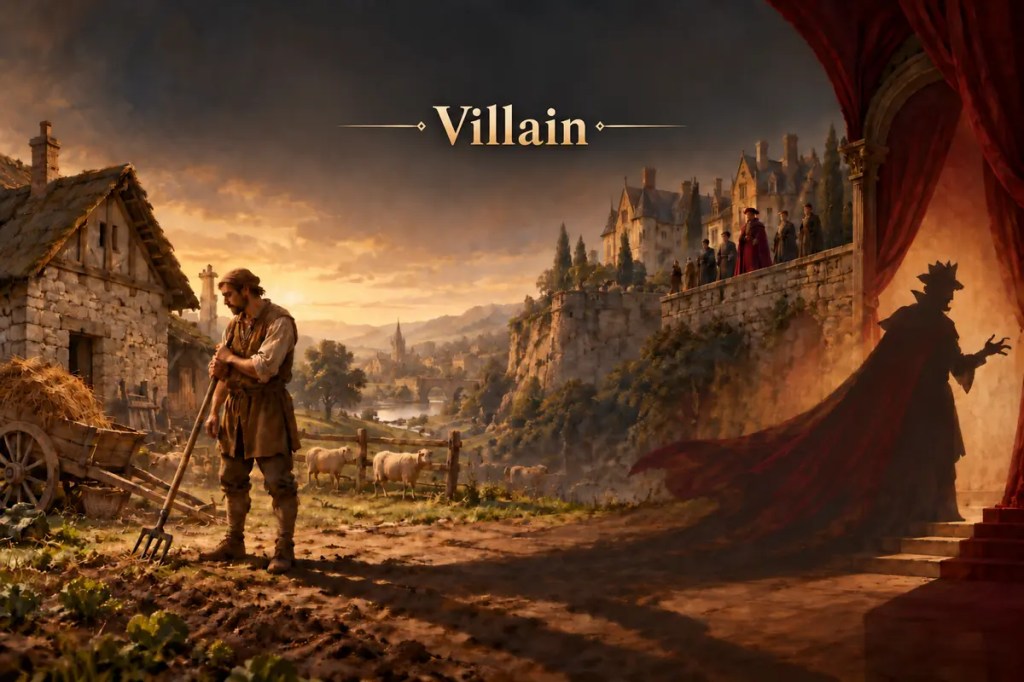
Every story seems to need a villain: the figure who threatens the hero, breaks the rules, or carries the blame. Yet the word did not begin in castles, crime, or moral darkness. Its earliest ancestors pointed toward the countryside—and toward the ordinary people who worked there.
1. From the Villa to the Villager
Villain entered Middle English in forms such as vilain and vilein, borrowed through Anglo-French. Behind them stood Medieval Latin villanus, meaning an inhabitant or worker associated with a villa—a country estate, farm, or rural settlement.
In the medieval social order, the related English form villein came to name a peasant whose freedom and obligations were tied to a lord’s land. The modern spellings eventually separated: villein retained the historical legal and social meaning, while villain carried the word’s increasingly hostile judgments.
The beginning, then, was not “evil person.” It was a label shaped by place and class—someone of the farm or village rather than the court, manor hall, or urban elite.
2. When Social Rank Became Moral Character
Words often preserve the prejudices of the people with the power to use them. Among medieval elites, the rural laborer could be portrayed as coarse, low-born, or lacking refined manners. A term for social position therefore became an insult for an uncouth or contemptible person.
The change reveals a familiar linguistic pattern: differences in class were recast as differences in character. To call someone a villain no longer merely located that person within a rural hierarchy; it suggested that low status, rough manners, and low morals belonged together.
By the sixteenth century, the judgment had sharpened. Villain could mean a scoundrel or a person capable of serious wickedness. The farm had faded from view, but the contempt attached to the farm worker remained inside the word.
3. The Villain Steps onto the Stage
Once villain meant a wicked person, it was ready for a new cultural role. In novels, plays, and later films, the word became the name of the character whose motives or actions drive conflict against the hero. This explicitly narrative sense is recorded from the nineteenth century.
Modern English still uses the word for deliberate criminals and scoundrels, but it also uses it more flexibly. A policy, habit, chemical, institution, or even bad weather may be called “the villain” when it is blamed for a problem. In public arguments, to “make someone the villain” is to assign that person the role of chief wrongdoer in a simplified story.
This modern use shows how completely the word has moved from geography to narrative. A villain is now defined less by where someone belongs than by the part that person—or thing—is made to play.
The history of “villain” is itself a story about power: a word for a rural worker was darkened by class contempt, transformed into a moral accusation, and finally cast as the enemy in the stories we tell.


Leave a comment