
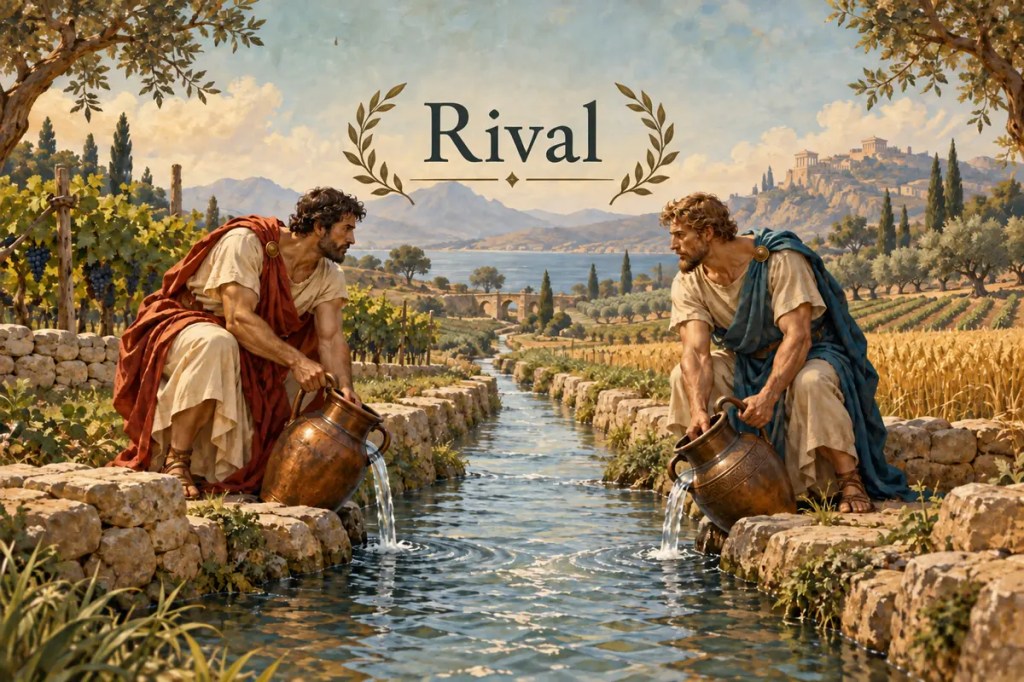
Rivals meet everywhere: on playing fields, in elections, across markets, and within stories. The word sounds as if it has always belonged to competition, yet its oldest image is quieter and more elemental—two people beside the same stream, each depending on its water.
1. Two People at One Stream
Rival came into English through Middle French or directly from Latin. Its source was the Latin noun rivalis, which could mean a person who used the same stream as another. Behind it stood rivus, the Latin word for a brook or stream.
Water gave neighbors a resource in common, but not necessarily in harmony. People drawing from one channel could share a right while also disputing access, timing, or quantity. The word therefore contained both proximity and potential conflict: a rival was close enough to want what another person also needed.
Latin had already extended rivalis beyond literal water users. It could refer to a rival in love, someone seeking the affection of the same person. When the word appeared in English in the late sixteenth century, competition rather than the stream had become its central idea.
2. From Shared Water to Shared Ambition
The shift from water to rivalry is a compact metaphor for competition itself. Two neighbors at one brook pursue the same limited resource; two suitors, candidates, or merchants likewise pursue an object that cannot always be possessed equally.
Early English uses described a person pursuing the same object as another. During the seventeenth century, the meaning broadened toward someone who strives to equal or surpass another. Rivalry no longer required a single prize: comparison alone could create the contest.
That change also preserved an older ambiguity. A rival may be an adversary, but a rival is also a peer—someone near enough in ability, status, or claim to make comparison meaningful. Competition and equality remain intertwined in the word.
3. Rival in Modern English
As a noun, rival names a person, team, company, or nation competing for advantage. As an adjective, it appears in phrases such as “rival teams” or “rival candidates.” The verb means either to compete with something or to approach it in quality: a new achievement may rival an older one.
Modern expressions reveal both sides of the history. A “longtime rival” suggests sustained contest, while “without rival” means without an equal. The same word can therefore point toward opposition or acknowledge excellence.
Rivalry can sharpen performance, identity, and ambition, but it can also turn shared ground into a boundary. The word still carries the structure of its first scene: two parties close together, joined by what they value and divided by their claims upon it.
“Rival” began beside a shared stream. Its history reminds us that competitors are often connected before they are opposed—drawn together by the very thing each hopes to claim.


Leave a Reply