
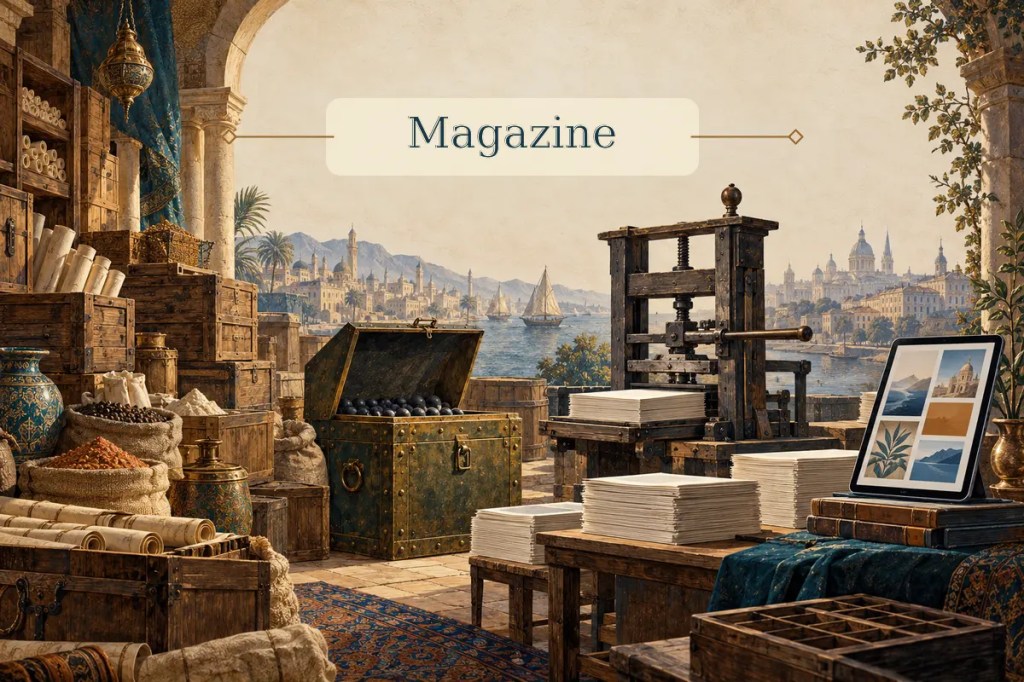
Today, a magazine is a curated sequence of articles, images, and ideas. Yet the word did not begin on a newsstand or a screen. It began behind the doors of a storehouse, carrying a history in which goods, gunpowder, printed knowledge, and digital stories all became things gathered for later use.
1. A Storehouse in Arabic
Magazine ultimately traces to Arabic makhzan, meaning a storehouse, with the plural makhāzin. The noun belongs to a family built around the idea of storing or laying something away. Through Mediterranean trade, the word travelled into European languages, appearing in Italian as magazzino and in French as magasin.
English adopted the word in the late sixteenth century for a warehouse or depot, especially one holding military supplies. A magazine could therefore be a practical building: a guarded place where provisions, weapons, or ammunition were kept until needed. The earliest English meaning was not a publication but a container of material value.
2. From Gunpowder to Printed Pages
The military sense became particularly durable. Forts and ships called their secure rooms for gunpowder and explosives magazines, and the word later named the chamber or detachable holder that stores cartridges for a firearm. In each use, the underlying image remained the same: a reserve held in readiness.
In 1731, the publisher Edward Cave gave that image a literary turn with The Gentleman’s Magazine. Its title presented the periodical as a storehouse of varied reading—a collection of essays, reports, poems, and other materials gathered into one recurring publication. The metaphor proved so useful that magazine became the ordinary English name for this kind of periodical.
As printing expanded, magazines developed identities of their own: scholarly reviews, illustrated weeklies, fashion journals, political monthlies, and specialist titles. What had once described a room full of supplies came to describe an edited space full of subjects.
3. One Word, Several Containers
Modern English still preserves the word’s older architecture. A print or online magazine stores a selected body of writing and images; a firearm magazine stores cartridges; and the rarer warehouse sense remembers the original depot. These meanings are not accidental homonyms but branches of one idea.
The publishing sense also shows how metaphor can outlive technology. Paper issues may become websites, apps, newsletters, or multimedia editions, but the magazine remains a deliberately assembled collection. Its value lies not only in individual pieces but in the act of bringing them together.
Magazine is a verbal storehouse: a word that moved from warehouses and powder rooms to printed pages and digital screens. Across every meaning, it preserves the same quiet promise—that something worth keeping has been gathered here.


Leave a Reply