
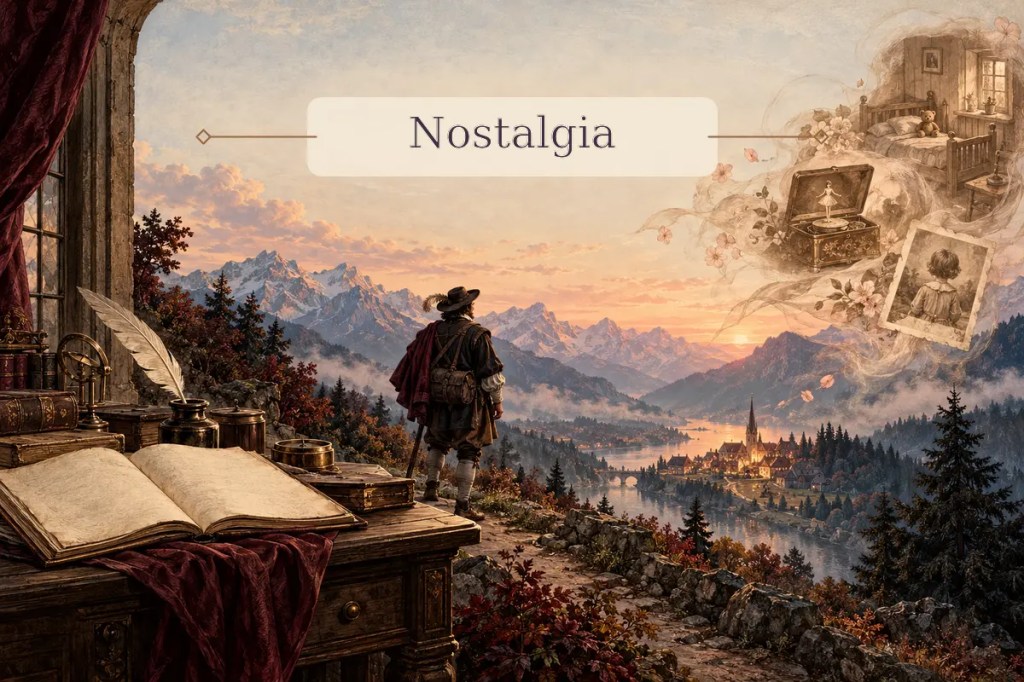
Nostalgia now feels soft: an old song, a childhood room, the glow of a photograph from another decade. Yet the word was not invented for pleasant reminiscence. It began as the name of an illness—a pain caused by being unable to return home.
1. A New Word for the Pain of Homecoming
Nostalgia was coined by the Alsatian physician Johannes Hofer in a medical dissertation presented at Basel in 1688. He wanted a learned name for the condition expressed in German as Heimweh—literally, “home-woe” or homesickness. His New Latin term gave that familiar suffering the authority of a medical diagnosis.
Hofer built the word from Greek nostos, “return” or “homecoming,” and algos, “pain” or “grief.” Its literal image is therefore not memory alone but an aching wish to complete a journey home. The same ending appears in medical words such as neuralgia, where -algia still signals pain.
Although its parts were Greek, nostalgia was not an ancient Greek word. It was a seventeenth-century scholarly construction, shaped to sound classical. English recorded it in the eighteenth century, when it still referred primarily to severe homesickness rather than affection for the past.
2. When Homesickness Was a Disease
Early medical accounts associated nostalgia especially with Swiss people living far from their native mountains, including soldiers serving abroad. Physicians described an intense fixation on home accompanied by sadness, anxiety, loss of appetite, weakness, disturbed sleep, and other bodily symptoms. In the medical thinking of the period, longing could become physically dangerous.
The diagnosis spread through European military medicine during the eighteenth century. By the nineteenth, the word could describe the homesickness of sailors, prisoners, migrants, enslaved people, and soldiers from many countries. What had first been presented as a peculiarly Swiss illness became a general name for the distress of forced or prolonged separation.
As medicine and psychology changed, nostalgia gradually lost its status as a distinct bodily disease. The idea of homesickness remained, but the word began moving away from a place that could perhaps be reached and toward a time that could not. By the early twentieth century, its now-familiar sense—wistful yearning for the past—was becoming established.
3. The Past Becomes a Kind of Home
In modern English, nostalgia is usually a bittersweet pleasure in recalling something that no longer exists: childhood, a former community, an earlier style, or an imagined “better time.” It can be private, awakened by a smell or melody, or collective, attached to a generation, a nation, or a vanished cultural world.
The emotion does not reproduce the past exactly. Memory selects, arranges, and sometimes romanticizes. That is why nostalgia can offer continuity and comfort while also simplifying history. The word may describe a tender personal bond, an artistic mood, a marketing strategy, or a political appeal to an idealized earlier age.
Yet its original structure still explains its power. Nostos promises return; algos acknowledges that return may be impossible. Modern nostalgia treats the past as a home carried in memory—a place the mind can revisit even when life cannot.
Nostalgia began as the diagnosis of a traveller who could not go home and became the name of an emotion felt by anyone who cannot go back in time. The word itself preserves both halves of that experience: the imagined homecoming and the pain of knowing it is beyond reach.


Leave a Reply