
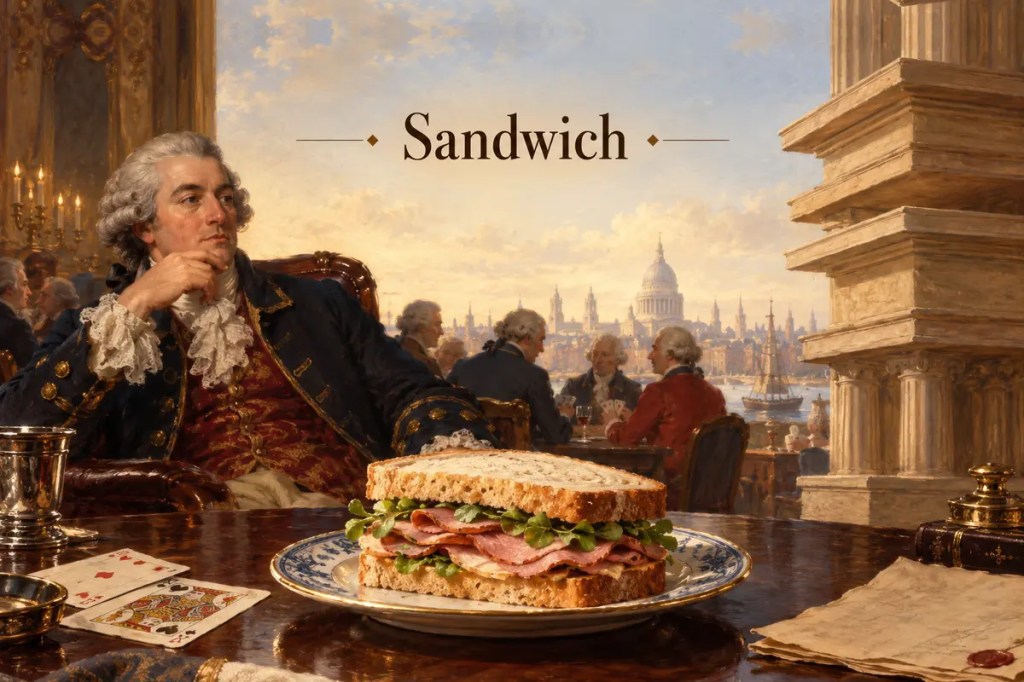
A sandwich seems almost too ordinary to have a biography: bread, a filling, and a meal that can travel in one hand. Yet its name is an aristocratic title, borrowed in eighteenth-century London and transformed from a person’s designation into one of the most adaptable words in everyday food.
1. A Meal Named After an Earl
The food sense of sandwich comes from John Montagu, the fourth Earl of Sandwich, an English statesman who lived from 1718 to 1792. Sandwich was already the name of a town in Kent and a hereditary title; when people applied it to bread enclosing a filling, a place-name and a family title entered the general vocabulary.
The Oxford English Dictionary’s earliest evidence for the food word dates from 1762, in the writing of the historian Edward Gibbon. The form was therefore circulating in London during Montagu’s lifetime. It did not name a newly discovered combination of bread and food—people in many cultures had eaten such combinations for centuries—but a fashionable way of referring to one particular convenient serving.
A famous story says that the earl ordered meat between slices of bread so that he could continue gambling without leaving the card table. The tale helped preserve the name, but its details should be treated as tradition rather than a secure account of invention. What the evidence supports is the association: the dish was linked to Montagu strongly enough that others began ordering “the same as Sandwich.”
2. From Fashionable Snack to Portable Meal
At first, the word belonged to the world of eighteenth-century clubs, late suppers, gaming, and fashionable society. A compact portion of cold meat held by bread suited rooms where conversation or play mattered more than a formal meal. The novelty lay as much in the social label as in the ingredients.
During the nineteenth century, the sandwich moved far beyond aristocratic fashion. Urban growth, industrial schedules, railway travel, and street vending all favored food that was inexpensive, portable, and quick to serve. Fillings multiplied, and the word became a broad category rather than the name of one recipe.
That expansion also made sandwich culturally flexible. Different breads and local ingredients produced tea sandwiches, club sandwiches, submarine sandwiches, bánh mì, and countless regional forms. The English label travelled widely, even as many societies retained their own older traditions of wrapping, layering, or enclosing food with bread.
3. A Noun That Learned to Become a Verb
In modern English, a sandwich most commonly means food placed between slices of bread or inside a split roll, though dictionaries also recognize open-faced forms. The word can identify a meal, a category on a menu, or a structure defined less by particular ingredients than by layers and enclosure.
By the early nineteenth century, English had also turned the noun into a verb. To sandwich something is to place it tightly between two other things: a thin office between taller buildings, a meeting between appointments, or one musical piece between two others. The edible arrangement became a spatial metaphor.
That metaphor explains the word’s durability. Sandwich is specific enough to summon bread and filling, yet abstract enough to describe almost anything held between outer layers. A noble title became a common noun, then a verb and a pattern—an entire grammar of things placed in the middle.
Sandwich did not give English a new way to combine bread and food; it gave an ancient habit a memorable new name. From an earl’s title to a portable meal and finally to a verb of arrangement, the word shows how language can turn a social fashion into an everyday structure.


Leave a Reply