
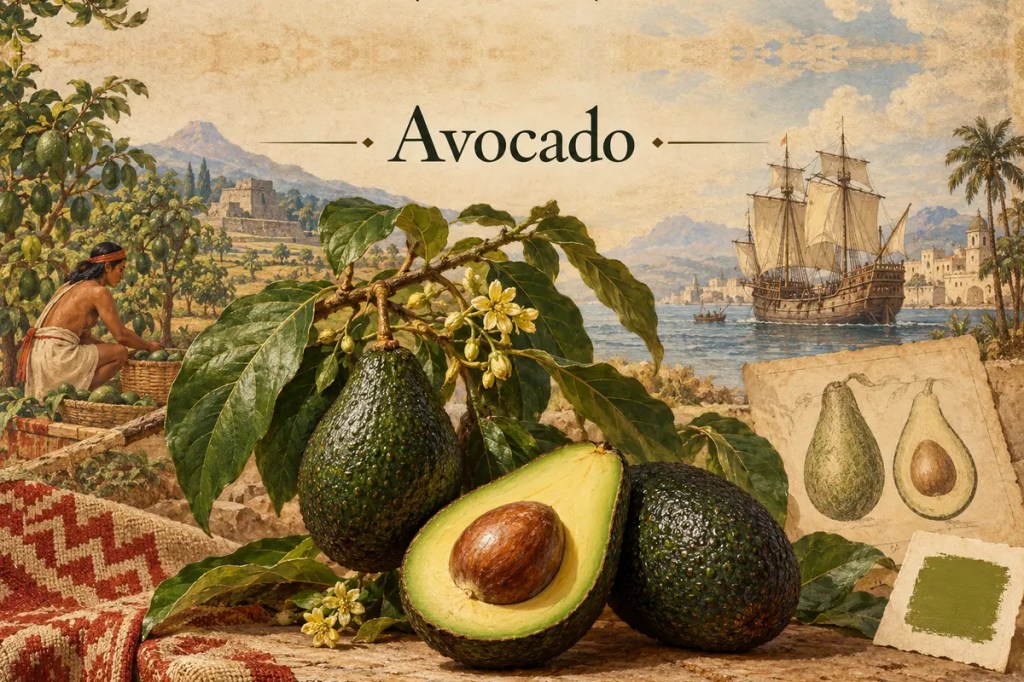
Avocado sounds comfortably modern: a green fruit associated with salads, toast, and global health culture. Its name, however, crossed several languages and an ocean before reaching English. Along the way, unfamiliar sounds were repeatedly reshaped into familiar ones, producing a word whose history is almost as layered as the fruit itself.
1. From Nahuatl Ahuacatl to Spanish Aguacate
The story begins in Nahuatl, the language of the Aztec world and many communities in central Mexico. The Nahuatl word āhuacatl named the avocado fruit and its tree. Spanish speakers in the Americas adapted the unfamiliar sound as aguacate, the form that remains standard in much of the Spanish-speaking world.
Historical dictionaries also record a secondary association between āhuacatl and “testicle,” often explained by the fruit’s shape and the way avocados grow in pairs. That striking detail is frequently repeated as though it were the word’s complete definition. The evidence is more cautious: “avocado” was the primary meaning, while the anatomical sense appears as an additional or slang usage in a sixteenth-century Spanish-Nahuatl source.
Spanish then reshaped aguacate again. The form avocado was influenced by an older Spanish word meaning “advocate” or “lawyer,” related to modern Spanish abogado. This was folk etymology: speakers pulled a borrowed word toward a more familiar native pattern, even though lawyers had nothing to do with the fruit.
2. Voyagers, Pears, and a Fruit with Many Names
English encountered the fruit through Spanish colonial and Caribbean networks. One early English record appears in the explorer William Dampier’s account published in 1697, where he described an “avogato pear” with soft flesh and a large stone. The shifting spellings—avogato, avocato, and eventually avocado—show English speakers still testing how to reproduce the borrowed name.
Because the fruit was pear-shaped, English writers often added pear. Another popular form, alligator pear, probably grew from a further sound-based alteration of Spanish aguacate or avocado. The rough skin made “alligator” seem visually appropriate, but the name did not originate with the reptile.
The fruit itself had been cultivated in the Americas long before Europeans arrived. After Spanish expansion, avocado trees spread through the Caribbean and other tropical and subtropical regions. As cultivation and international trade grew, the name avocado gradually displaced many competing English forms and became the commercial standard.
3. From Regional Fruit to Global Word
In modern English, avocado refers both to the tree Persea americana and to its rich, oily fruit. The word also developed a color sense: “avocado” can describe a muted yellow-green, especially the shade that became fashionable in twentieth-century interiors and appliances.
The name belongs to a wider family of Nahuatl words that entered international vocabularies through Spanish. Guacamole, for example, comes from Nahuatl āhuacamōlli, combining the word for avocado with mōlli, meaning sauce or mixture. Everyday menus therefore preserve traces of Indigenous American languages even when speakers do not recognize them.
Today the avocado’s global popularity can make the word seem detached from place. Yet its sounds still map a historical route: Nahuatl āhuacatl, Spanish aguacate, the altered Spanish and English forms, and finally modern avocado. Each stage records not a simple translation, but an attempt to make a foreign word pronounceable and familiar.
Avocado is more than the name of a fruit. It is a linguistic traveller, carrying an Indigenous Mexican word through Spanish contact, Caribbean trade, English folk etymology, and global commerce. Its history reminds us that borrowed words rarely cross borders unchanged: languages taste them, reshape them, and make them their own.


Leave a Reply