
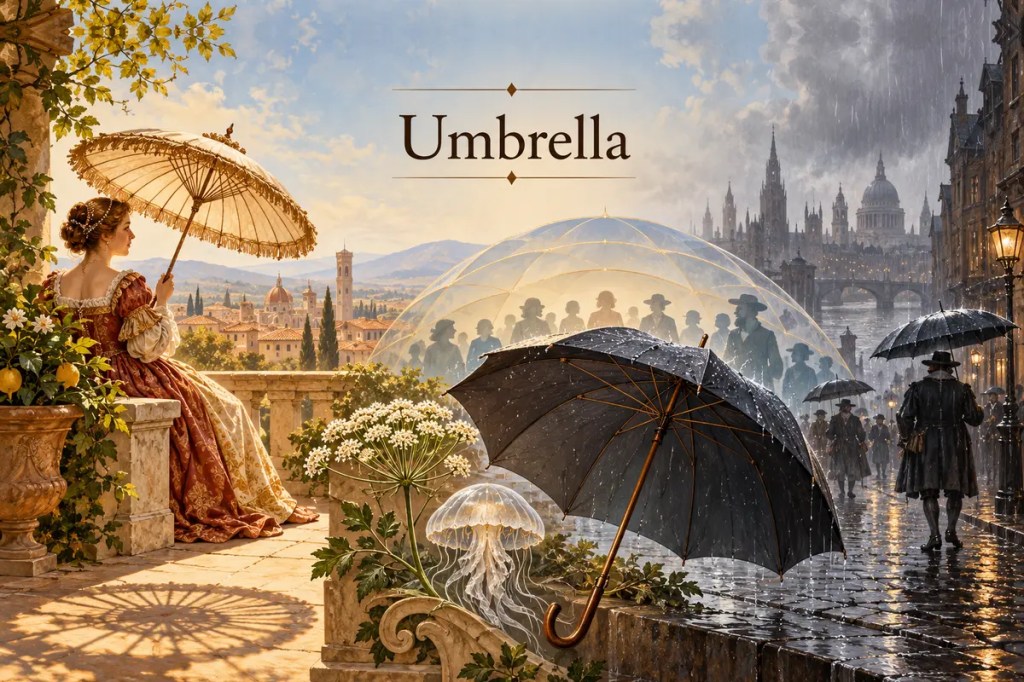
An umbrella seems inseparable from rain: a familiar object opened on wet streets and forgotten in doorways. Yet the word did not begin with rain at all. Its oldest roots belong to shade and shadow, and its journey into English followed the object from the sunlit Mediterranean into the changeable weather of northern Europe.
1. From Latin Umbra to Italian Ombrella
The deepest root of umbrella is Latin umbra, meaning “shade” or “shadow.” Latin also had umbella, a diminutive form referring to a small shade or sunshade. In Late Latin, the form developed into umbrella, influenced by the familiar sound and meaning of umbra.
Italian inherited the word as ombrella or ombrello. The object it named was a portable canopy used chiefly for protection from the sun. Its linguistic relatives still preserve that original idea: French ombre and Italian ombra both mean “shade” or “shadow,” while English umbrage also descends from the same Latin source.
English travelers encountered both the object and its Italian name. In 1611, Thomas Coryate described people in Italy carrying “umbrellaes,” leather canopies held above the head against the sun. English adopted the foreign word with several early spellings, including umbrella, ombrella, and umbrello, before the modern form became standard.
2. When a Sunshade Met English Rain
In Mediterranean Europe, shade was the object’s defining purpose. In England, however, the same folding canopy found another obvious use. Historical dictionaries record umbrellas being used against rain by the 1630s, only a few decades after the word’s earliest English appearances.
For a time, umbrella and parasol could overlap. The second word came through French and Italian from elements meaning “to shield from the sun.” As habits changed, English increasingly reserved parasol for a light sunshade and used umbrella for the more practical, weather-resistant device carried in rain.
The umbrella also carried social meaning. In parts of Asia, Africa, and Europe, elaborate canopies had long marked rank, ceremony, or royal authority. Early English descriptions sometimes treated the object as foreign or fashionable before it became ordinary street equipment. A symbol held above rulers gradually became something almost anyone might carry to work.
3. From Folding Canopy to Protective System
Modern English still uses umbrella for a collapsible canopy that protects against rain or sun. The object’s radiating shape also supplied technical meanings. The rounded body of a jellyfish can be called its umbrella, and umbrella-shaped clusters appear in botanical language through the related term umbel.
The central idea of protection encouraged a powerful metaphor. An umbrella organization brings several groups under one structure; an umbrella policy provides broad coverage; and a military or nuclear umbrella promises protection over a territory or alliance. In each case, an invisible system performs the work of a canopy.
The phrase under the umbrella of now suggests both shelter and inclusion. It can describe ideas, departments, laws, brands, or communities gathered beneath a larger category. The physical object has therefore become a model for organizing the abstract world: one cover, many people or things beneath it.
Umbrella began not with a storm, but with a shadow. From Latin shade to an Italian sun canopy, from English rain protection to a metaphor for institutions and alliances, the word has kept one idea at its center: something above us that creates safety below.


Leave a Reply